Confederate Army In Wayne County, Tennessee During The Civil War

2nd (Biffle’s) Tennessee Calvary Battalion (Read the Unit History)

9th (Gantt’s) Tennessee Calvary Battalion (Read the Unit History)

19th (Biffle’s) Tennessee Calvary Regiment (Read the Unit History)

  • Company B
  • Company F
  • Captain J.W. Phillip’s Light Infantry Company – Roster & Unit History

The Lost Units


Union Soldier’s Grave

Union Soldier’s Grave
Lauderdale County, Alabama

Lat: 34° 59¢ 57² N
Lon: 87° 45¢ 51² W

Contributed by David Leon Montgomery on 16 December 2006.


Union_Soldier0003


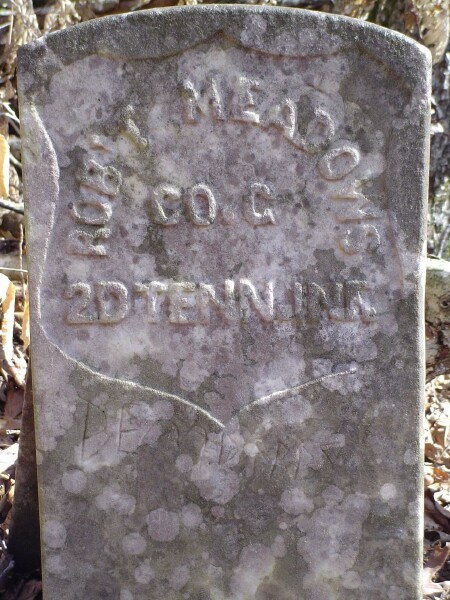
An individual who lives in the immediate area of this grave informed me about this Union soldier’s final resting-place. He has hunted the surrounding woods almost all of his life and has known of its location for many years. According to this person, the grave was excavated by a person/persons probably looking for Civil War relics. The person/persons digging in the earth, dug down about four or five feet deep. By most grave standards, the headstone is always placed to the west of the gravesite. It appears that they didn’t know on which side of the headstone to dig. There has been no evidence or rumors of anything being found since it is believed they dug on the wrong side.

The headstone was removed from the gravesite in the 1980’s and was gone for about two years. Suddenly, it was returned and placed in the exact spot with the lettering to the west as originally placed. According to the inscription on the stone, Meadows was attached to Company “G” of the 2nd Tennessee Infantry. But he is listed in the Company “D” roster, of the 2nd Tennessee Infantry, also a Union Army unit. He enlisted at Savannah, Tennessee on January 15, 1864. He was mustered in February 1, 1864 at Nashville, Tennessee.

Union Army in Wayne County, Tennessee During the Civil War

6th Tennessee Calvary (Read the Unit History)

2nd Tennessee Mounted Infantry (Read the Unit History)

8th Tennessee Mounted Infantry (Read the Unit History)

10th Tennessee Infantry (Read the Unit History)

Union Soldier’s Grave

Civil War in Wayne County

No major battles were fought in Wayne County, Tennessee during the Civil War. However, the armies of both the Union and the Confederacy traversed the county numerous times during the period of the war. An estimated 100,000 soldiers, both Union and Confederate, marched through Wayne County, Tennessee. The result was devastation for the people of the county. By 1865 the county seat of Waynesboro had been abandoned because of the constant threat of armies marching through. Food and supplies were exhausted through the county.

In 1861, the people of the county voted in the majority to remain in the Union, although there was a strong secessionist sympathy. When the State of Tennessee seceded from the Union, several companies of Confederate soldiers were raised in Wayne County. The men in these units came from all the various districts of the county, although the majority were from the Buffalo River area and from the Houston and Craven’s Mills area.

So great, however, was the sympathy of a majority of the people for the Union that as soon as General Grant’s army marched into Savannah in March 1862, many men of Wayne County walked or rode to Savannah and volunteered for Union service. These men joined Ohio, Illinois and Indiana units stationed with Grant at Savannah.

Following the Battle of Shiloh in April 1862, General Grant sent Captain Edward R. Bladen to Brantley’s Crossroads (in the area of present day Cromwell Crossroads) in Wayne County, Tennessee to recruit volunteers for Union service. Over 200 men volunteered at this time, forming the units of Co. A and Co. G of the 10th Tennessee Infantry.

By the end of the war, over 2500 men from Wayne County, Tennessee were either in Confederate or Union service. The only people left at home were old men, women, and children, who struggled to raise enough food to feed their families and protect their property from both the armies and marauding guerrillas.

On the following pages we will attempt to provide information on Confederate and Union Units and on the men who served in those units, as well as some history of the many skirmishes which took place inside the boundaries of the county during the war.

If you have information on any Wayne County, Tennessee resident or native, who served either the Union or the Confederacy, please let us know. We will be happy to add your information to these pages.


WAYNE COUNTY, TENNESSEE WAR BETWEEN THE STATES VETERANS BOOK AVAILABLE AT THE WAYNE COUNTY HISTORIAN’S OFFICE IN THE COURTHOUSE  FOR $60.00 OR CALL 931 722-5016 AND ASK PRICE W/SHIPPING AND HANDLING THEN SEND CHECK TO WAYNE COUNTY HISTORICAL SOCIETY, P.O. BOX 866, WAYNESBORO, TENNESSEE 38485


Biographies from “Who’s Who in Tennessee” (1911)

The following biographical sketches were published in the book “Who’s Who In Tennessee – A Biographical Reference Of Notable Tennesseans Of Today” in 1911. The sketches appear on page 568 and 589.


BOYD, Frank, lawyer, born Vesuvius Furnace, O. July 30, 1859; Scotch-Irish and German descent; son of G. W. and Ann E. (Songer) Boyd; father, manufacturer of pig iron; educated at Mars Hill College near Florence, Ala, graduated from law department Cumberland University Lebanon, Tenn. B. L. degree 1881; worked on farm in early life, married Laura E. Hassell, May 29, 1883; member W.O.W. and K. of P., Democrat; presidential elector for the 7th Congressional district on Cleveland and Hendrix ticket, 1892; delegate to National Democratic convention at Chicago, 1896; member of Christian church; superintendent of public instruction for Wayne County, Tenn. 1885; organized first institute ever held in county for both white and colored schools; elected attorney general of 11th judicial circuit of Tenn. in 1894, served eight years; elected State Senator from counties of Giles, Lawrence and Wayne, Nov 8, 1910; original charter member of first telephone company organized in county and of first turnpike company, organized since 1860; one of original promoters of Bank of Waynesboro, Tenn., the first bank established in the town and the only one; member of firm of Boyd & Morrison, lawyers since 1901.

CATON, Daniel Spencer, farmer, born Davie Co., N.C., July 23, 1849; Scotch-Irish descent; son of Drury and Emily (Woods) Caton; received common school education; entered farming in early life; married Mary Ann Phillips, Dec. 23, 1869; member of Wayne Co. Farmer’s Union and president of same; Democrat (Regular); served as magistrate of Wayne Co. Tenn, 1886-92; and was a member of Tenn. Legislature 1897 and 1898; member of M. E. church, South. P.O. Address, Waynesboro, Tenn., R. F. D. No. 5

COLE, Jasper E., public official; born Wayne Co., Tenn., Jan. 17, 1863; Scotch-Irish descent; son of John H. and Nancy A. (Linn) Cole; educated at Waynesboro, Tenn.; in April, 1881, he made a trip to Texas, returning home Nov. 1886, and became clerk in store of Turman, Helton & Co., Jan 1 to Jul 1, 1887, and returned to Texas, same year; in year 1888 he made a trip to Arkansas; returned from Arkansas to Tenn. same year; then removed to Texas in 1894 again and engaged in farming, returned to Waynesboro, Tenn., in 1899; married Sallie B. Taylor, July 12, 1890; member F. & A. M., No. 127, I. O. O. F. No. 36, W. O. W. No. 238, sheriff of Wayne Co., Tenn. by appointment of court Oct. 1893 to Sep. 1894; chairman of County Court, 1901-02-03-04-05; justice of the peace since 1900; 1905 was selected one of Five Commissioners to build new courthouse and served as secretary of board; elected Trustee of Wayne Co. Aug 1910.

COPELAND, William Brownlow, farmer, born Martins Mills, Tenn., May 16, 1867, Scotch-Irish descent; son of James D. and Caroline (Williams) Copeland; father was a farmer; paternal grandparents James and Katie (Gillis) Copeland; maternal grandparents Jack and Rebecca (Williams) Williams; received common school education; entered farming in early life; married Janie Lawson, Sept. 15, 1887; member Masons, I.O.O.F, W.O.W., and M. W. of A. Republican; former Trustee for Wayne Co. Tenn., two terms; member M. E. church.

DAVIS, Joseph N., farmer; born Lawrence Co., Tenn., March 6, 1845; English descent; son of David H. and Matilda (Wakefield) Davis; father minister of the gospel; paternal grandparents, William and Elizabeth (Matison) Davis; maternal grandparents, Abel and Katie (Stuckey) Wakefield; educated Hardin Co., Tenn.; entered farming in early life, served in U.S.A. 1863 – 65, also in Spanish-American war, 1898; married Nancy Copeland, Jan. 16, 1867; member of Farmers’ Educational and Co-operative Union of America; member of Missionary Baptist church; engaged in farming and mercantile business at Waynesboro, Tenn.

GALLIEN, John W., teacher; born Wayne Co., Tenn., Sept. 17, 1869; son of Greene and Mary E. (Murphy) Gallien; father’s occupation farmer; paternal grandparents, Abner and Kate (Westmoreland) Gallien; maternal grandparents, Colvin and Sarah (Linnville) Murphy; educated in country schools and commercial department of Ky. University; began career as a farmer; married Maude House, Dec. 26, 1900; Republican; justice of the peace, 1906-1909; member of County Board of Education of Wayne Co., Tenn., 1907-1909; at present he is superintendent of public instruction for said county.

CYPERT, John W. – (b. 1826)

Submitted by Donita Barkley, excerpt from “Reminiscent History of the Ozark Region”.


Ability, when backed by enterprising measures and progressive ideas, will accomplish more than any other professional requirement, an illustration of which may be seen in the career of Hon. John W. Cypert, who is the efficient county and probate judge of Baxter County, Arkansas. He was born in Wayne County, Tennessee, April 22, 1826, a son of John and Nancy (Anderson) Cypert, the latter of whom was born in Virginia and the former in Tennessee. They were married in the father’s native state and partly reared their family there, but in 1850 took up their residence in Searcy County, Arkansas, where the mother breathed her last in 1862, at the age of seventy-two years. The father died three years later in his seventy-fifth year, having held the office of justice of the peace while in Wayne County, Tennessee. He was quite an active politician and was a deacon in the Baptist Church for many years. Hon. John W. Cypert was one of the youngest of twelve children born to his parents, and in the schools of Wayne County, Tennessee he received his education. March 13, 1845 he was married to Sarah Lloyd, a daughter of F. W. Lloyd, and by her became the father of eleven children, seven of whom are living:

Thomas F., a farmer and stonecutter of Baxter County, Arkansas; Minerva, wife of John Weaver, a farmer of this county; John H., a farmer and stonecutter of this county, who is now serving in the capacity of deputy county sheriff; James R., who is a farmer of Morrow County, Oregon; Mary E., who is the wife of Hezekiah McCourtney, of Lead Hill, Boone County, Arkansas; and Nancy E., wife of M. B. Parks, a farmer of this county; Sarah is the widow of Henry C. Lewallen and is living with her father, Judge Cypert. Those dead are William F., who was about fourteen years of age; Newton L., who was about twelve; Louisa A., was the wife of Dr. W. C. Parks, of this county; and Alice T., wife of W. E. Green, of this county.

In 1850 Judge Cypert moved to Izard County, Arkansas, where he purchased a woodland claim, and with the able assistance of his wife and growing family he improved it in many ways. At the opening of the war he was in good circumstances, but during that time his losses were very heavy, and after hostilities had ceased for several years he moved to that part of Fulton County which eventually became the eastern part of Baxter County.

In July, 1861, he became commissary of McCarver’s Confederate regiment, but on account of the measles, was discharged from the service, after which he joined J. T. Coffee’s regiment as captain of Company E, and was with Price on his Missouri raid, his eldest son, Thomas, being also in this raid. He (Thomas) was taken prisoner at one time, but at the end of nine days was discharged. Judge Cypert, when a resident of Izard County, served ten years as county treasurer, and two years as justice of the peace and associate judge.

In 1874 he was elected to represent Baxter County in the Constitutional Convention, and in 1882 was elected probate and county judge, in which capacity he served four years, and after a lapse of four years was elected for another term, and re-elected for second and third terms.

He and his wife are members of the Missionary Baptist Church, and socially he is a Royal Arch Mason, and for a long term served as master of his lodge. In the chapter he served several years as high priest, and has represented his lodge and chapter many times in the Grand Lodge of the State. Politically he is a Democrat. He is eminently capable of filling any position within the gift of the county, and is very popular in a political, social and business way.

COOK Jr., John (1797-1873)

John Cook Jr. was born 1797 in North Carolina to john cook sr. They moved into Kentucky and made their way into Tennessee into Wayne County TN. There John, Jr. met & married Deborah Martin born 1800 North Carolina. She was living in the Martin Mills area there in Wayne County. They married in 1819 there in Wayne County TN & have the distinction of obtaining the first marriage license issued in Wayne County. John & Deborah had 12 children.

Alexander Cook, born 1820-William Cook born 1823 David Cook born 1825 Martin Cook born 1827  Melissa Cook born 1832  Christopher Columbus Cook born 1834

Samuel Cook born 1835 James Cook born1836 Mary Cook born 1837 Charles Cook born 1839 John Cook born 1841 Thomas Jefferson Cook born 1844.
John & Deborah moved to Tishomingo County,  Mississippi in what was called the Eastport area. The last two of there children being born in Tishomingo County. Sometime around 1855 all of them but Martin moved to Grice, Texas, Upshur County. In 1860 William moved back to Tishomingo county to live and fought in the civil war with his brother Martin. Alexander Cook’s home in Gilmer, Texas has been named a Texas historical landmark. John Cook Jr. had 11 brothers and sisters. He died 1873 in Upshur County, Texas. Deborah died 1873 in Montague, Texas.

My name is Tim Cook.  I am the GG-Grandson of John Cook, Jr.

Submitted by Tim Cook.

COOK, Martin (1827-1877)

Martin Cook born August 17,1827 in Wayne County TN, in the Indian Creek area. He moved to Tishomingo County, MS, into the Eastport area in the early 1840’s. He was the son of John Cook, Jr. He met and married Clearrinda Autry on November 24,1853 in Tishomingo County. He was a veteran of the Confederate army Co. G, 26th Mississippi Infantry.

Six children were born to this union:
Mahala Cook, born Nov.1,1855, died Feb.24,1856
Mary Harriette Cook, born Nov.5,1856, died 1936.
Armintie Atra Cook, born June 9,1861, died 1928.
Absolom Martin Cook, born June 27,1864, died July 30,1947.
James Alexander Cook, born March 3,1868, died April 29,1931.
Selena Caroline Cook, born 1872, died 1938.

Martin died Dec 7,1877 and is buried at old Pleasant Hill Cemetery north of Iuka. Clearinda died June 30,1903 and is buried at Shiloh Cemetery, Hardin County TN. All of Martin’s children have passed on but his grandchildren still live in Mississippi and still visit Tishomingo County and Wayne County, TN till this day

Submitted by Tim Cook.

Henry, Robert Selph (1889-1970)

Robert Selph Henry was born at Clifton, Wayne County, Tennessee on 20 October 1889, the son of Robert Allison Henry and Jemima Emily Selph. His parents were married 28 Dec 1887 in Clifton. Jemima Emily Selph was the daughter of Dr. Irby N. Selph, noted physician in Clifton.

Not long after his birth, Robert Selph Henry moved to Nashville, Tennessee with his family. He graduated from Vanderbilt in 1911 and did post graduate work at Queens College in Cambridge, England. He was admitted to the Tennessee bar in 1911 and practiced law in Nashville, Tennessee from 1915 to 1921. In 1921 he became assistant to the president of the Nashville, Chattanooga and St. Louis Railroad and remained in that position until 1934.

Henry was a student of the South and the Civil War. His book, “The Story of the Confederacy” published in 1937, was considered for many years to be the definitive history of the rise of the Confederate States of America and the Civil War (or War of Rebellion/ War Between the States).
Robert Selph Henry died in Nashville, Tennessee, 19 August 1970.


List of Books Published:
1. “The Story of the Confederacy”, New York, Grosset & Dunlap, 1937
2. “First With The Most – Gen. Nathan Bedford Forrest”, Indianapolis, Bobbs-Merrill, 1944.
3. “The Story of the Mexican war”, New York, F. Ungar Publishing Co., 1961.
4. “Headlights and Markers; An Anthology Of Railroad Stories” edited by Frank P. Donovan, Jr. and Robert Selph Henry, San Marino, California, Golden West Books, 1968.
5. “Portraits Of The Iron Horse: The American Locomotive In Pictures and Story”
drawings by Otto Kuhler; story by Robert Selph Henry, Santa Fe, NM, Sunstone Press, 1976.
6. “This Fascinating Railroad Business”. Bobbs-Merrill, about 1943
7. “Trains”, Bobbs-Merrill, about 1934
8. “On The Railroad” (no bibliographical information available)
9. “The Armed Forces Institute of Pathology: Its First Century, 1862-1962” (no bibliographical information available)


Obituary: “Nashville Banner” Wednesday, August 19, 1970

Robert S. Henry, Author, VU Board Member, Dies
Robert Selph Henry, 80, author, historian, retired railroad executive and life member of the Vanderbilt University Board of Trust, died after a lengthy illness today at his home, 813 Clovercrest Drive, Alexandria, Va. Services will be at the Everly-Wheatley Funeral Home in Alexandria before the body is brought here to the Finley Dorris and Charlton Funeral Home for services. Burial will be in Mt. Olivet Cemetery here. Exact times of the services have not been set.

        A native of Clifton, Tenn., he was a son of the late Robert Allison and Emily James Selph Henry and moved to Nashville with his family at an early age. He was graduated from old Wallace University school, and received the A. B. and LL.B. degrees from Vanderbilt.

        Mr. Henry was appointed to the Vanderbilt Board of trust in 1940 and was named a life trustee in 1960.
He did post graduate study at Queen’s College, Cambridge, England and later was a reporter for “The Nashville Banner” and for “The Tennessean”. Following his newspaper work he served as secretary to the late Gov. Ben W. Hooper from 1913 to 1915. He also was one of the four founders of the Nashville YMCA Night Law School.

        He served as a field artillery captain in France in World War I, and later, was Tennessee chairman of the fund campaign for the late Sgt. Alvin C. York. He retired from the Army Reserve as a lieutenant colonel.
Mr. Henry was vice president in charge of public relations for the Association of American Railroads at the time of his retirement in 1958. He went to Washington when he association was formed in 1934, serving first as assistant for public relations to the AAR president. From 1921 until 1934 he was director of public relations and later assistant to the vice president of the Nashville, Chattanooga and St. Louis Railway in Nashville. 
An anthority on the Civil war and the railroad industry, Mr. Henry had written and spoken widely on both subjects. He had made numerous addresses here.

His latest publication was a revised edition of “The First With The Most, Forrest”, a colorful biography of the famed Confederate general, Nathan B. Forrest, and a history of the Confederacy from 1861 to 1865. It was first published in 1944 and was re-issued in April of this eyar. Among his other books were “the Story of the Confederacy”, “The Story of Reconstruction”, “The Story of the Mexican War”, “This Fascinating Railroad Business”, “Trains”, “On The Railroad”, “Portroits of the Iron Horse”, and “The Armed Forces Institute of Pathology: Its First Century, 1862-1962”.

        In 1954, Mr. Henry received the Gold Medal Award of the Washington Civil War Round Table of the District of Columbia, for his writings about the Civil War. He was first president and second gold medal winner of the organization.

        Mr. Henry had been president of the Southern Historical Association and was chairman of the Board of Trustees of the Ladies Historical Association here from 1926 until 1934.
He was a past president of the Vanderbilt Alumni Association and had been chairman of the Continental Membership Committee of the Railroad, YMCA. Mr. Henry was a life member of the Civil War Round Table of Alexandria, a member of the Alexandria Sons of Confederate Veterans, a member of the board of the Historic Alexandria Foundation and a member of the Alexandria Association.

        He was an elder of the Westminster Presbyterian Church of Alexandria and a former member of the old First Presbyterian Chruch in Nashville. He had addressed hundreds of organizations throughout the county and had received many honors, including an honorary doctor of literature degree from the University of Chattanooga.

He was married to the former Lura Temple in 1929. She survives.
Other survivors are two daughters, Mrs. N. Biurkey Musselman, Alexandria; and Mrs. George B. Vest, Jr., Athens, Ga; a brother, Douglas Henry, Nashville; and five grandchildren.

Sources:
1. Crutchfield, James A., “Timeless Tennesseans”, The Strode Publishers, Huntsville, Alabama,
2. “Nashville Banner”, Wednesday, August 19, 1970, – obituary – Tennessee State Library and Archives, vertical files.
3. Library of Congress, Card Catalog, http://lcweb.loc.gov
4. Virginia State Library and Archives, catalog, http://eagle.vsla.edu
5. Plott, Irma M., compiler, “Wayne County, Tennessee Marriage Records, 1857-1929”, The Byler Press, Collinwood, TN, 1983
6. Brown, Doris R., transcriber, “The 1880 Census of Wayne County, Tennessee”, The Byler Press, Collinwood, TN, 1986
7. Wayne County Historical Society, “Cemetery and Death Records of Wayne County, Tennessee”, The Byler Press, Collinwood, TN, 1987