Fielding Churchwell – Convict Record

From Wayne County. Convicted of Grand Larceny and sentenced to three years from 14 June 1842. Rec’d 15 June 1842. He is 24 years old, 5 feet 8 inches in height, weighs 162 lbs. born and brought up in Wayne County about eight miles from Mount Jasper Furnace and 15 miles northeast of Waynesboro. He has a wife and two children living with her father Jos. Staggs two miles from Mount Jasper Furnace on the waters of 48 Mile Creek. He has two sisters in Hardin County about six miles from Savannah near the road leading to Purdy. One married to a man by the name of Blanton, the other to a man by the man of Brumley. — (Record of Convicts, Rec. Group 25, Vol. 45, p. 162. TSLA)

Fielding Churchwell, age 24, born in Tennessee. Occupation: labourer. Convicted of Grand Larceny by Circuit Court in Wayne County and sentenced to three years in the Penitentiary. Received 14 June 1842, discharged 21 Apr 1845. Pardoned under the act of 1836. — (Convict Record, Rec. Group 25, Ledger 86: 534. TSLA)

Submitted by Edgar D. Byler, III


Riley H. Melton – Convict Record

Riley H. Melton. From Wayne County. Convicted of Petit Larceny by Circuit Court, Wayne County. Sentence: 3 years. Rec’d at State Penitentiary 14 Oct 1841. He is 19 years old, weighs 117 lbs., 5 feet 6 inches high. Born in Bedford County 12 miles from Shelbyville, three miles from Fishing Ford on Duck River. His father, John Melton now lives in Wayne County, 12 miles from Waynesboro on the Florence Road. He has fair hair, blue eyes, and fair skin, tolerable good countenance.
(Record of Convicts, Rec. Group 25, Vol. 45, p. 120. TSLA)

Riley H. Melton, age 19, born in Tennessee, occupation: labourer. Convicted of Petit Larceny by Circuit Court, Wayne County and sentenced to 2 years in the Penitentiary. Received 14 Oct 1841, discharged 14 Oct 1843. Conduct fair.
(Convict Record, Rec. Group 25, Ledger 86: 534. TSLA)


Submitted by Edgar D. Byler, III

Matthew Murphy – Convict Record

Matthew Murphy from Wayne County – Offence Larceny

Sentence 3 years. Received at State Penitentiary March 26th 1839. He is 28 years old, weights 167 lbs. 5 feet 10 inches high. Born and brot up in Lawrence District S. Carolina. his father John Murphy lives in Lauderdale County Alabama 13 miles north of Florence. his wife and one child is living with his father. he has 4 brothers and four sisters. the all live in Lauderdale County Ala. he is a farmer by profession.
(Record of Convicts, Rec. Group 25, Volume 45, p. 114. TSLA)

Matthew Murphy, received 27 Mar 1839, Grand Larceny from Wayne County. 28 years old farmer, 3 year sentence. born SC. Released 12 Feb 1842. Pardoned by Gov. Jones. — (Convict Record, Rec. Group 25, Ledger 86, TSLA)

The trial of Matthew Murphy on an indictment for Grand Larceny was held in Wayne County Circuit Court 1838. He was convicted and sentenced to three years. Case was appealed to the Tennessee Supreme Court but not record of case found in Supreme Court records. Minutes of the case are lost. Only record in Wayne County is the Docket Book for 1836 – 1842 which lists the case.


Submitted by Edgar D. Byler, III

Some Early Settlers of Wayne County

By Charles M. THOMPSON. Reprinted from “The Clifton Mirror”, Clifton, Tennessee, “Anniversary Edition” of 20 October 1905.


“Some time ago the editors of the “Mirror” made a request of Mr. C. M. THOMPSON of Houston to furnish us with her early reminiscences of the early history of Wayne County. Mr. THOMPSON replied with an installment which we published several weeks ago when we published his life sketch. In this second [editor’s note: actually first installment] installment he deals with the early settlers. All Wayne County people in particular will find this article exceedingly interesting. The contribution follows:

Editor’s Mirror,

By your request I will give you now some of the early settlers of Rain’s Creek (now known as Indian Creek).

My father, Zachariah THOMPSON, Jesse CYPERT, and John CYPERT came to Wayne County in the year 1818 together with Francis CYPERT, their father and also the grandfather of the undersigned. Robert CYPERT, a brother of Francis, and a soldier in the war of 1776, came with the above and all settled on Indian Creek.

My father settled the place where Joseph SIMS (the son-in-law of J. N. DAVIS) now lives. This farm has never passed from the connection. Robt. CYPERT, the old soldier, built the first mill on Indian Creek. It was built on the George WHITE farm, a few hundred yards southwest of the corner of J. N. DAVIS’ land and was a failure. The old man then moved up the Creek about seven or eight miles and built a mill on what is known as Johnson’s Fork of Indian Creek, near the place where the Martins Mills now stands. This mill went into the hands of Willoughby PUGH, from PUGH to Samuel COOPER, from COOPER to Archibald WALKER, from WALKER to the CROMWELLS, from the CROMWELLS to the MARTINS, the present owners.

Soon after the CYPERTs came to Indian Creek, Isaac HORTON, an old soldier of the war of 1776, and his three sons, Isaac, Nathaniel and William came to Indian Creek and settled just below the old mill. It might be of interest to record the sons of Jesse, Baker and John CYPERT.

Jesse CYPERT had seven sons. John L. was a Baptist minister (correction: preacher) and was one of the organizers of the Indian Creek Association. Zachariah, William C., James, Thomas P., Robert Jasper and Jesse N. CYPERT. The latter is the only member of the family now living. He resides in Searcy, White County, Arkansas. He served one term as judge of his county. Baker CYPERT had only one son. His name was Samuel and he now resides in the State of Oregon. John CYPERT had six sons, Jesse, Robert, Anderson, Thomas J., John W., and James W. CYPERT. Thomas J. CYPERT was captain of a company in the Federal Army, served in the Legislature of Tennessee two terms as Senator, was assessor of Internal Revenue for the sixth collection district of Tennessee and was a preacher for several years before his death. His brother John was a Captain in the Confederate Army in Arkansas. The members of this family have all passed over the river.

Henry RAYBURN came to the county a little later than the CYPERTs and settled near the mouth of Rayburn Creek, where it empties into Indian creek thence its name.”

C. M. THOMPSON, Martins Mills, Tennessee.


Second Installment, published in “The Clifton Mirror”, 10 November 1905, page 8.

“Inasmuch as my last article missed the waste basket, I will come again. In my former contribution I mentioned Henry RAYBOURNE as being one of the early settlers of this county. It might be well enough to give a short sketch of him and his family.

“Squire RAYBOURNE served for years as justice of the peace for his civil district. He had four sons and three daughters. His oldest son, Gen. John RAYBOURNE was a very prominent man in the county. He was sheriff for a number of terms, surveyor and a state senator. The names of the other three sons were Samuel, Davidson, and Elihu. The latter died young and never married. Squire RAYBOURNE was the grandfather of John A. SMITH and his sister Tennie, who live near Old Town in Hardin County; he was the grandfather of Charley SMITH of Cerro Gordo and of Mrs. Joseph HARRISON living near Saltillo. The two old people, son, daughter and infant are buried in the old apple orchard near the old home.

“Thos. BROOKS settled at an early day and the farm remained in the family for several years. It then passed to Wm. PARKER, father of John Y. PARKER and an uncle of your townsman, C. C. STRIBLING. John Y. PARKER now owns and lives on this farm.

“About a mile above the creek Andrew DOWNING settled. He came with three son: John, William and Jonathan to Indian Creek about the same time BROOKS did. John DOWNING settled across the creek at the place N. W. BRATCHER now lives. Wm. DOWNING, I think, went further down the creek, perhaps in Hardin County. Jonathan remained on the old homestead until about 1860-61 and moved to West Tennessee. After the war, R. J. CYPERT bought him out, the farm having been divided and changed hands several times. John W. MIDDLETON now lives on the Old DOWNING homestead and in the house that DOWNING built.

“The next farm on the creek above was settled by David SHULL. This farm changed hands several times. After SHULL came J. R. HUGHLING, then Col. Jacob BIFFLE (BIFFLE lived on it when the war came up) then Luther FARRIS, an uncle to Dr. Will FARRIS of your town. After FARRIS, A. F. HASSELL, after HASSELL, Daniel EATON, after EATON, James RIGHT and after RIGHT, the present owner Dr. E. R. YEISER.

“The next farm of note that I will mention is that of J. N. DAVIS. It was settled at an early date by David GALLAHER who remained on it for several years. It passed from GALLAHER to Wm. PARKER and from him to his son Frank. From Frank PARKER to Capt. David I. DICKERSON from DICKERSON to the present owner, J. N. DAVIS.

“I will now cross the creek opposite to place of the writer’s birth to the David TACKETT farm. MR. TACKETT was a large land owner. His farm has been divided and sub-divided. The names of the parties occupying the lands formerly owned by TACKETT are Samuel DAVIS, Bart LAY, Will and Marion LINDSEY, Joe ROBERSON, John ROBERSON, Thos. MARTIN, Wm. NOWLIN and Wm. SCOTT.

“This brings me to the Wm. YOUNGBLOOD farm. Mr. YOUNGBLOOD came to Indian Creek at an early date and settled the farm where his grandson Zachariah HORTON now lives. Mr. YOUNGBLOOD raised three children: Josiah, Lidda, the mother of Zachariah HORTON, and John William, the father of Joe and Mat YOUNGBLOOD.”

C. M. THOMPSON, Martins Mills, Tennessee


Third Installment, published in “The Clifton Mirror”, 24 November 1905, page 1

“Here I came again. As I started out to give a short sketch of the early settlers of this section of Wayne County, I will resume by dropped down from upper Indian to what we call lower Indian.

“Squire A. B. GANTT came to Indian creek at a very early date from Bedford County, Tenn. and bought an improvement from an old gentleman by the name of Jesse O’STEEN and settled what is now known as the GANTT farm – I think the second best farm in the county.

“Squire GANTT served several terms as justice of the peace but never held any other county office. He had three sons, L. B., W. M. and A. B. GANTT and several daughters. They have all passed away except three daughters who now reside in Texas. The farm is divided and is now owned by J. Y. PARKER and W. W. JOHNSON.

“I now cross the creek to the farm where Daniel EATON lives. It was settled at an early date by Phillip CANARD who did not live but a few years. His widow remained on the farm until her death. After that it passed to Mr. HERNDON. From HERNDON to J. and E. B. MARTIN, and from MARTIN to the present owner, Daniel EATON.

“I will now cross the creek to the farm settled by George HAWK. It passed from HAWK to David COOK, a great-uncle to your townsman, Dr. COOK. After COOK it passed to Wm. J. STRAYHORN (Mr. STRAYHORN was a very prominent and influential man in this neighborhood). After STRAYHORN to Ledford NEIGHBORS and thence to the present owner, Samuel H. SINCLAIR.

“I see in the last issue an extract from a letter written by Dr. Wm. T. CHILDRESS of Terrel, Texas. He resided just across the creek south of the S. H. SINCLAIR farm and practiced medicine for ten or twelve years. Dr. CHILDRESS is well known in this neighborhood and a man who stood high in his profession.

“I will not give a short sketch of John COOK. He came to Indian Creek at an early date and settled on the farm adjoining Daniel EATON on the West side and lying in the fork of Indian and Weatherford Creeks. Mr. COOK had four sons: David, Martin, Christian and John COOK. The latter is said to have obtained the first marriage license issued in Wayne County. His bride was a Miss MARTIN, a sister of the late John A. MARTIN of Martin’s Mills. Mr. COOK was a German by birth and a hatter by trade. He was the great-grandfather of your townsman, Dr. COOK, and the grandfather of H. C. GREESON. Mr. COOK also had three sons by his second wife: Austin, Henry, and Frederick. The latter lives just across the line in Hardin County, on a portion of the land formerly owned by Hugh McCARN.

C. M. THOMPSON, Martins Mills, Tennessee


Fourth Installment, published in “The Clifton Mirror” 22 December 1905.

Mr. C. M. THOMPSON of Martin’s Mills who has been contributing a series of articles to the Mirror on the early settlers of Wayne County continues his histories sketch with the following communication:

“Editors Mirror

“Since my last article found a place on your front page, it is a pleasant inducement for me to write again.

“Continuing a sketch of the early settlers of Indian Creek, I wish to say that Messrs. Frederick ROSE, William BECKHAM and Green BECKHAM came to Indian Creek with or about the time John COOK did. Rose settled the farm across the creek north of the Daniel EATON farm. He had four sons, William, Phillips, Eli and Eanis. All settled in the same neighborhood together with William and Green BECKHAM. The former was the father of Zachariah BECKHAM, who raised twenty-one children to be men and women – fifteen sons and six daughters and all had families. Mr. BECKHAM was married three times.

“I will now pass up Weatherford Fork of Indian Creek, to the farm now known as the John SINCLAIR farm. It was settled by Stephen STUBBLEFIELD about the year 1819 or 20 and passed from STUBBLEFIELD to John SINCLAIR, (father of S. H. SINCLAIR of your town) about the year 1830, and has remained in the family to the present time.

“The above farm adjoining the latter on the south was settled by James SMITH at an early date. It passed from SMITH to William SINCLAIR, a brother of John, and remaind in the family until two or three years ago when it passed to the present owner, Jack BREWER.

“Douglass GILLIS, a Methodist preacher, settled the farm just across the creek, west from the latter and built the first camp ground that was built in this section of the county. Mr. GILLIS sold out to the SINCLAIR’s and mvoed to Horse in Hardin County, where he remained until his death.

“Jas. COPELAND, a brother-in-law of Mr. GILLIS, came to Weatherford’s Fork about the same time GILLIS did and settled the farm adjoining the above. COPELAND had five sons and one daughter. The names of the sons are Thomas S., Daniel G., James D., William and Joseph M. COPELAND. The latter is the grandfather of your townsman, Elihu DAVIS. The COPELAND farm is now owned by J. B. COPELAND, a grandson of the old man, having never massed out of the family.

“I now come to the Pinhook farm as it was known. This farm was settled by William Weatherford (thus the name of the creek) about the year 1818-1819 and was the first settled on the creek. Weatherford was part Indian and claimed to be related to Old Chief WEATHERFORD. He had four sons, Joel, Hill, John and William. The latter died young and never married. The farm passed to the Rev. W. P. KINDRICK.

“Mr. KINDRICK possessed considerable wealth and was above the average ability. He was a fine pulpit and stump orator and was a candidate for Congress at one time being defeated by the Hon. Barkley MARTIN. KINDRICK had three sons, W. P., James, and Clay. The latter died in the Confederate Army and was never married. The first son, W. P. Jr. was a very prominent man and served one term as State Senator and ranked high as an orator. He ran for Congress and was defeated by the Hon. John V. WRIGHT. Mr. KINDRICK was captured while organizing a regiment for the Federal Army and was sent to Libby Prison, and was one of the men who escaped through a tunnel and returned to Clifton. He died soon afterward and was buried in his own garden in Waynesboro, now owned by John F. MORRISON, attorney-at-law.

“James KINDRICK made his home at Florence, Alabama, and represented his county in the state legislature. Rev. Wm. P. KINDRICK was the grandfather of Dr. James BARLOW of Savannah. His wife was a sister of Judge CLAY of Alabama and also a cousin of the great statesman, orator, and politician Henry CLAY of Kentucky. The KINDRICK family have all passed away.

“I will in the near future have something more to say about the early settlers of the Pinhook neighborhood provided it is agreeable with the editor.”

Mirror Editor’s note: “Come ahead, Uncle Charlie, our space is at your disposal. Your article this week is exceedingly interesting and we are sure our Wayne County readers in particular will enjoy it. Ed.”


Fifth Installment, published in “The Clifton Mirror”, 12 January 1906, page 1.

“As I stated in my last communication that I would have something to say concerning a few more of the old settlers in the Pinhook Community and having been granted the permission of the editor to continue this series of articles, I will do so by stating that Gregory SINCLAIR, a brother to John and William SINCLAIR, bought land from Pryor YATES and settled the Pinhook farm, SINCLAIR living on this farm for several years and accumulating considerable property, both real and personal, but concluded that he could do better out west, so he sold to his nephew, William SINCLAIR, a son of John SINCLAIR, who remained on the farm until his death. His widow still occupies the old homestead.

“William SINCLAIR, Jr., was a very prominent man in his neighborhood and was a man of more than the ordinary talent. He served as Justice of the Peace for several years and ranked high as a gentleman, socially, religiously, and masonically.

“The farm adjoining the latter on the south was owned by Richard MOORE (Uncle Dickey), the father of Mastin MOORE of Hardin County and Thos. MOORE of Hardin’s Creek, the father of Richard and Ed MOORE and also the uncle of Dr. K. L. COOK of Clifton.

“The SINCLAIR family, John, William and Gregory, together with their father and two sisters came from Ireland to N.C., thence to Wayne County, Tennessee. John was a horse doctor, William a blacksmith, and Gregory, a weaver.

“The farm adjoining the Pinhook on the East at the mouth of Bear Creek was owned for several years by Benjamin WATKINS, but was sold to Wm. SINCLAIR, Sr. and remained in the family until the old man’s death. Since that time it has changed hands several time. The present owners are John HOUSE and the widow of John D. STRICKLIN.

“The farm adjoining the latter was owned at an early date by Rev. Wm. BAKER, the grandfather of Thos. J. GILLIS, living just across the line in Hardin County. BAKER sold to James A. LAWSON. The farm on the east of this was owned at a very early date by Robert SIMS, the grandfather of Robt. M. SIMS, attorney-at-law, Clifton, and also the grandfather of Thetis SIMS of Linden, the present member of Congress from the 8th district. Mr. SIMS had four sons, M. J., Robert, G. W. (father of Thetis), and A. M. (father of your townsman). SIMS sold to James A. LAWSON.

“The farm adjoining the latter on the east was settled by Nathaniel MARIN [editor’s note – surname probably MARTIN), and passed to Wm. SINCLAIR, Sr., and after him to James A. LAWSON.

“Next comes the farm settled by A. J. MARTIN, which remained in the family until about a year ago when it passed to James M. LAWSON, a grandson of James A. LAWSON.

“The next farm was settled by John N. GILLIS and passed to James A. LAWSON. LAWSON was a large land owner. He had four sons, Samuel, G. W., Thos. J., and John M. LAWSON. They are all living but the latter, and occupy the farms purchased by their father. These farms are all on Bear Creek of Weatherford’s Fork.

“If this misses the waste basket, I will come again. Wishing the editor a happy and prosperous New Year, I am, Yours truly, C. M. THOMPSON, Martin’s Mills.”


Sixth Installment, published in “The Clifton Mirror” 16 February 1906.

“Having been some time since writing you last, I have concluded to write another short sketch of the first settlers of Wayne County.

“Mr. Ben HARDIN, a land speculator, came to the county about 1817 and settled the form now known as the Gallaher farm on Factor’s Fork of Shoal Creek where the old Notchey Trace cross’d said creek (This trace was the road Gen. JACKSON cut on his march from Nashville, Tennessee, to New Orleans, the latter part of the year 1814, just before he fought the battle that is known in history as the battle of New Orleans which occurred on the 8th day, Sunday, January 1815.) The farm is still owned by the GALLAHER heirs having never passed out of the family.

“The farm lying east and adjoining the William YOUNGBLOOD farm, spoken of in an earlier article, was settled by a Mr. James GIPSON in the year 1819 or 1820, passing from him to Elijah HARBOUR. Mr. HARBOUR had three sons, Samuel, Elisha, and Elijah, and two daughters. The two first named settled in Hardin County, Sam settled on Turkey Creek about three miles above Old Town.

“Mr. HARBOUR’s farm was divided and subdivided and finally passed out of the family. Elisha settled on Indian Creek some two miles below the line. The farm settled by HARBOUR is one of the best farms on Indian Creek, this said farm never having passed out of the family. The present owner is the great-grandfather (Ed. – he means great-granddaughter) of the original settler. She is Mrs. Minnie MARTIN and is the daughter of your townsman, Mr. S. H. SINCLAIR.

“Elijah fell heir to his father’s farm and sold it to A. B. GANT and went to Mississippi. Before being divided, this was the best farm in the neighborhood. Mr. GANT divided it between his two sons, L. B. and W. M. GANT. The latter sold his to James HORTON and S. A. KING, while L. B. GANT sold his a few years fore the war between the states to Henry L. BURKETT and went to Texas. When the war came, MR. BURKETT took his family and went South, his oldest son going into the Confederate Army.

“After the war closed they settled in Mississippi and a few years later Frank BURKETT was Grand Master of the Masonic Lodge of the State of Mississippi. Henry BURKETT came back to this state and sold his land to R. C. MARTIN and Mr. MARTIN’s daughter, Mrs. Charles BOYD, is the present owner.

“The farm adjoining the Elisha HARBOUR farm on the east in Hardin County was settled by Kenneth MURCHISON, the great-grandfather of your townsman, Dr. K. L. COOK (this is his name) Said farm passed to Hugh McCARN, who accumulated considerable wealth both real and personal. He had four sons and two daughters by his first marriage and two daughters by his last marriage. The four sons were named Neal, Daniel D., John and William. The latter married but did not live but a year or two. Neal and John emigrated to Arkansas before the war. Daniel G. still remains in this county and is the only member of the family now living so far as the writer knows.

“Mr. McCARN owned a large farm at one time, but it is all owned by other people with the exception of what is owned by Daniel G. and Thomas J. GILLIS, who is a nephew to the old man.

“I guess I had better ring out before my contribution falls into the waste basket.”


Editor’s note: The Sixth Installment was the last article of the series found. If there were other articles contributed by Charles M. THOMPSON, the issues of the newspapers have not survived and therefore the articles are lost.


General John Bell Hood’s Invasion of Tennessee, October 1864 – January 1865

Written and submitted by Edgar D. BYLER, III

[Editor’s Note: This paper was presented to the Col. Jacob BIFFLE Camp of the Sons of Confederate Veterans, Waynesboro, Tennessee]


Confederate States of America President Jefferson Davis in July of 1864, appointed Gen. John Bell Hood of Texas as commander of the Army and Department of Tennessee. Hood’s orders and general plan of action were to stop US Gen. Sherman from taking Atlanta, Georgia. However, when Atlanta fell to Sherman’s forces on 2 September 1864, Hood was forced to reconsider his strategy.

Between the 2nd of September and the second week in October, 1864, Hood attacked Sherman’s positions wherever and whenever possible. Hood did succeed in destroying the railroad between Chattanooga, Tennessee and Atlanta, but his original intention of drawing Sherman out of Atlanta failed. Sherman cabled Gen. Thomas in Nashville that he was cutting loose and was on his way to Savannah, Georgia.

Hood now found himself in the unenviable position of attempting to shadow Sherman, trying to bring him into a pitched battle with of hope of defeating him, or Hood could strike what he thought would be a death blow to the Union by invading Tennessee. After conferring with Gen. Beauregard and President Davis, the decision was made to invade Tennessee. The Confederacy hoped that such an invasion would force Sherman to return to Tennessee to defend the strategic supply points of Nashville and Paducah, Kentucky.

Between October 9th and the 30th, Hood’s army, composed of three corps: Cheatham, Lee and Stewart, began a long, recuperative retreat into Alabama. The men who had been pushed and wearied by the assault on Sherman’s troops needed to be re-outfitted and re-armed. This was accomplished as well as was feasible at various points in northeastern Alabama.

Hood first attempted to cross the Tennessee River at Decatur, Alabama. But was unable to cross due to high water and the earlier destruction of the railroad bridge. He then ordered the army to proceed to Tuscumbia, where he arrived on the 30th of October.

Hood’s army of the Tennessee was strung out in camps between Tuscumbia, South Florence, Leighton and Bainbridge. Attempts were made to cross the Tennessee River by pontoon at Bainbridge, located above the shoals, but the pontoons were cut by Federal forces.

On the 31st of October, Gen. Stephen Lee’s forces began crossing the Tennessee River from South Florence. They ran into Federal troops under the command of Gen. Hatch and following a short skirmish, Hatch retreated toward Waynesboro, Tennessee. The Confederate forces under Lee marched into Florence, Alabama to the jubilant celebration of its inhabitants.

Between the 1st of November and the 20th, Hood experienced one delay after another. Gen. Forrest did not arrive in Florence until the 14th of November having been opposite Johnsonville, Tennessee before being ordered to join Hood at Florence. While Lee’s corps had successfully crossed the river, Cheatham and Stewart’s corps were still unable to cross due to high water and flood damage to the pontoon bridge. Cheatham finally crossed the river on the 12th and 13th, while Stewart was unable to cross until the 20th.

While Hood was waiting for Cheatham and Stewart’s corps to make it across the river, Forrest had arrived and was placed in command of all the cavalry units. Forrest immediately set out toward Lawrenceburg, Tennessee, harassing the Federal troops under Gen. Hatch at every turn. Hatch finally struck back at Forrest’s command on the 19th of November in a battle on Butler Creek in Wayne County, Tennessee. The battle proved inconclusive and Hatch withdrew toward Lawrenceburg with Forrest in hot pursuit.

On the 15th of November, Col. Jacob Biffle was apparently raiding from Ashland, Wayne County, Tennessee to Linden, in Perry County and Clifton in Wayne County. It was in Clifton that Biffle was joined by more of Forrest’s command who had crossed the river from west Tennessee. On the 16thof November, Biffle was camped on Indian Creek, Wayne County, Tennessee (near his home at Biffle Spring) and probably joined up with Col. Rucker of Forrest’s command who on that date was occupying Waynesboro, Tennessee.

 The records do not indicate where Biffle and Rucker were between the 16th and the 18th of November. They had probably moved out toward Lawrenceburg, Tennessee to join with Forrest’s main force. We know that they were not in Waynesboro, Tennessee on the 18th because on that date, Col. Horace Capron (US) of the 6th Division, 1st Brigade of Wilson’s Cavalry, had occupied the town with his force composed of men from the 14th and 16th Illinois Cavalry, the 5th Indiana and the 8th Michigan.

Capron did not occupy Waynesboro without a fight. He reported to Gen. Wilson and Gen. Schofield that he “occupied Waynesboro this evening [18th Nov] with the loss of 1 killed, 1 mortally wounded, 1 severely wounded, and that he had captured two scouts from Forrest’s command.” He stated that citizen intelligence reported Hood’s army was at Florence, Alabama and that Forrest was in the area around Lawrenceburg. Capron would remain in Waynesboro until the 22nd when he retreated to Mt. Pleasant and joined Gen. Hatch.

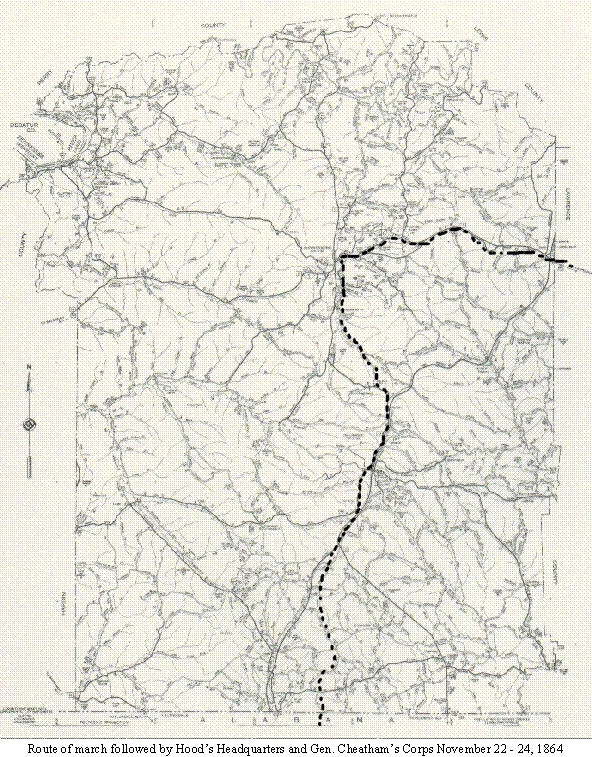
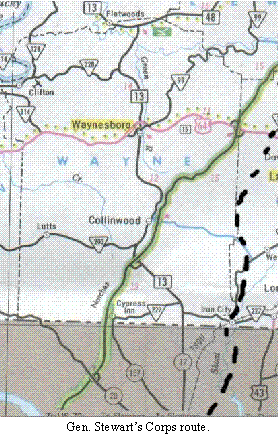
Finally, on the 20th of November, Hood was ready to begin his march. Stewart had finally crossed the river and had gone into camp six miles north of Florence on the old military road, camping at Wilson’s crossroads [now known as St. Florian]. Lee was about ten miles north of Florence on the Chisholm Road, while Cheatham and the Headquarters were just north of Florence on the old Waynesboro-Florence road [present day Cloverdale road]

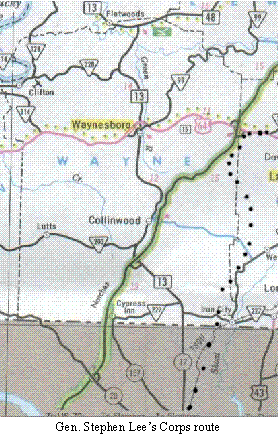
cheathamFrom this point until the army was united south of Mt. Pleasant, Tennessee it was spread out over a large area from Middle Cypress Creek on the west to the east of Shoals Creek. Hood’s plan was to have Cheatham’s corps and the Headquarters move north on the Waynesboro-Florence Road to Waynesboro and then on the old Columbia Central Turnpike to Mt. Pleasant. Lee would take the Chisholm Road north, moving toward West Point, Tennessee, then turn west onto the old Natchez Trace and then to the Columbia Central Turnpike. Stewart’s route remains somewhat of a mystery. He originally started out on the Military Road, but appears to have turned west near Pruitt’s Mill (Pruitton, south of Iron City, Tennessee) and followed behind Lee.

For all the soldiers marching north from Florence, Alabama, this was a time of celebration as well as despair — celebration because they were back in Tennessee which was home to many of them; despair because of the weather and their inadequate equipage and rations. When they left Florence, it was raining; but this quickly changed to snow and ice. The weather turned much colder and troops in Lee’s corps reported seeing icicles two feet long on Butler Creek. Add to this the fact that the roads were normally impassable in such weather, but were now a muddy morass because of the movement of the artillery pieces and baggage trains, it is a wonder that the troops made such good time. Often traveling 13 – 16 miles per day.

LeeOn the 21st of November, Hood’s headquarters were at Mr. Westmoreland’s house just west of the Cloverdale Road, near present day Pisgah Methodist Church. Cheatham was camped at Rawhide (Cloverdale). Lee had crossed into Tennessee near the old Van Leer furnace on Butler Creek with Stewart somewhere between Wilson’s Crossroads and Pruitton.

On the 22nd of November Cheatham had marched 18 miles north on the Waynesboro-Florence Road and was camped about 15 miles south of Waynesboro. The headquarters was in a deserted house about 14 miles south of Waynesboro (near the present intersection of the Natchez Trace Parkway and Tennessee Highway 13, south of Collinwood). Lee’s corps was camped between Wayland Springs and West Point; and Forrest was engaged in the Battle of Lawrenceburg with Gen. Hatch.

It is important to point out here that Gen. Hatch had been ordered by Gen. Thomas in Nashville, to hinder the advance of Hood’s forces as much as possible, but was not to fully engage them in battle. This was to allow Thomas time to get reinforcements from Paducah, Kentucky into Nashville to strengthen his force. This was not a surprise raid on Hood’s part and Thomas well knew the importance of Hood’s force of 36,000+ men advancing toward him. Thomas’ problem was that he didn’t know exactly where Hood was going to strike.

Cheatham left camp at the intersection of the Waynesboro-Florence Road and the Old Nashville Road (Natchez Trace) on the 23rd and arrived in Waynesboro by 4:00 P.M. It is believed that his corps and the Headquarters group followed the Trace to the area of McCalls passing through what is today Collinwood, then either turned down Chalk Creek or followed the old Green River Road.

They found Waynesboro deserted. All the townspeople had fled to the nearby countryside. Cheatham didn’t stop in Waynesboro, but continued on the old Columbia Central Turnpike towards Lawrenceburg. He went into camp that evening at Wayne Furnace. Lee and Stewart were still bogged down in western Lawrence County while Forrest had proceed up the Military Road to near Summertown.

On the 24th, Cheatham, along with Hood and his headquarters, left Wayne Furnace and marched 14 miles to Mrs. Chambers house on the old Columbia Central Turnpike (just north of Ovilla). Lee had crossed over into Wayne County, probably from Fish Trap Creek and turned north onto the Pinhook Road which left the Waynesboro-Lawrenceburg Road just above where Zion Baptist Church is today and intersected the Turnpike south of Ovllla. Stewart continued north up Chisum Creek, joining the Turnpike near Deerfield.

StewartBy the 25th, Hood’s headquarters was at Mt. Pleasant; Cheatham was south of Mt. Pleasant; Lee was on the Columbia Pike north of Mt. Pleasant, Stewart was at Henryville and Forrest was south of Columbia. By the 26th they were all at Columbia, Stewart’s corps bringing up the rear.

What followed was the Battle of Franklin and the Battle of Nashville where all Hood’s plans were dashed. Hood was a defeated man and submitted his resignation, the army was placed under the immediate command of Gen. Richard Taylor, later joining Gen. Joe Johnston for the denouement of the war.

One footnote concerning Wayne County following the battle of Nashville. The 30,000+ Federal troops who had been sent in pursuit of Gen. Hood’s retreating forces, were turned aside at Pulaski, Tennessee and made a quick march to Clifton, Tennessee where they were loaded onto transports and sent to Paducah, thence by train to Virginia for the closing episodes of the war.

Thus in the closing days of the war, Wayne County, Tennessee was to experience the trauma of two large armies passing through its territory. Everything that was not tied down or hidden was confiscated by first the Confederate troops, then the Union troops. The residents were left destitute.

Russ Hotel – Clifton, Tennessee

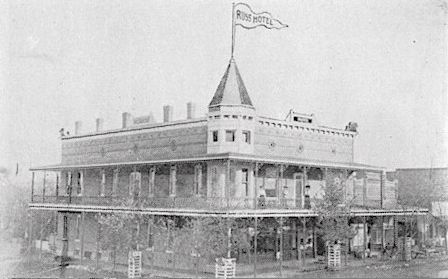
The Russ Hotel - (photograph from The Taylor~Trotwood Magazine, February 1907)

The Russ Hotel – (photograph from The Taylor~Trotwood Magazine, February 1907)

The Hotel Russ, A Palace for Travelers

This article was published in “The Clifton Mirror” Clifton, Tennessee, Friday, February 3, 1905. The Rust family, along with their related familiintention to have his own electric light plant, but he has decided to use the power now in course of furnishing by the new company, in which he is one of the principal stockholders. It should be added here that the doors, windows and sash were furnished by the Cottage Building Co., the iron by Geo. L. Meskey & Co., and the carpet, rugs and curtains by the Wm. E. French Co., all of Evansville. The hotel has its own water works and sewerage system. Mr. W. W. Atchinson and wife conducted the Hotel Russ

The Hotel Russ, A Palace for Travelers

This article was published in “The Clifton Mirror” Clifton, Tennessee, Friday, February 3, 1905. The Rust family, along with their related families, had settled in Wayne County between 1840 and 1850. It is said that the father of J. G. Russ admonished his son for changing the family name from Rust to Russ. Legend relates that this hotel was the host to German General Rommel prior to his North Africa campaign. Stated purpose for his visit was to study the tactics of Civil War General Nathan Bedford Forrest. Author of the article is unknown.

The commercial traveler—and his name is legion—may travel far and wide before he finds a cozier and more hospitable home in which to repose his restless bones for a brief season than the Hotel Ruses, a picture of which is presented herewith. We speak of the commercial traveler especially because he is the most ubiquitous bird of passage produced by this age of enterprise, but as a matter of fact the traveling public generally may find a warm welcome and generous treatment beneath the rooftree` of this hostelry. The Hotel Russ was thrown open to the public just one year ago. It was built by Mr. J. G. Russ, one of the wealthiest and most substantial citizens of Clifton, as well as one of the most enterprising. Mr. Russ was himself on the road for twenty years, representing the wholesale dry goods house of The Mackay Nisbett Co. of Evansville, Ind., and knows from practical experience the kind of accommodations that delights the hearts of the traveling fraternity. When he retired from his profession a few years ago he resolved to erect in Clifton a hostelry that would be a credit to the town, a never failing source of satisfaction to the caravan that passes this way, and that is incidentally a monument to his enterprise and generosity. The Hotel Russ is the result. The building is located at the corner of Water and Main streets, overlooking the beautiful Tennessee river, that sweeps in graceful curves and bends within the range of one’s vision until it narrows into a faint blue ribbon many miles away. It occupies a ground space of 100×85 feet, is three stories in heighth including a basement, and has added an attic and observatory. A 70-foot plumb line measures the distance from the flag pole to the ground. The building is finished in pressed brick and iron. A 10-foot veranda 95 feet in length fronts the Tennessee river, with an extension of 75 feet on Main street, making a total length of 170 feet. Large iron columns support this veranda and the balasters are of wrought iron. This veranda alone cost $1,500. From it one gets a magnificent view of the surrounding country, while a peep from the observatory enlarges the vision until on a clear day the country for many miles up and down the river is plainly visible. This hotel was build at a total cost of $20,000. Neither pains nor expense was spared to make it a model of its kind. Every department was carefully supervised and contructed under the immediate direction of the most competent craftsmen and artists in their respective lines. W. F. Hartman was the architect and forman. T. Wyche did the painting and graining. Herman Stoermer and son Fred did the brick work. J. W. Spain looked after the plastering and frescoeing. All of these parties, with the exception of Mr. Wyche, are from Evansville, Ind., and their work stands as an enduring monument to their skill. The hotel is furnished throughout in hard woods, oak being the predominating wood. There are twenty rooms in all. The first floor is given over to the lobby, dining room, reception room and living rooms. On the second floor are the parlors, guest rooms and bath rooms. A beautifully decorated bridal chamber opens off from the ladies parlor. This parlor is magnificently furnished in upholstered leather, and a bay window retreat furnishes a cozy corner for tete`-a-tetes. Just across the hall are two other Stoconnecting rooms of corresponding size, and the combination furnishes accommodations for the entertainment of a large party. In the spacious basement is the culinary department, we cannot penetrate its mysteries but a peep into its interior gives the masculine mind visions of substantials and delicacies for the inner man that set at rest any forebodings on this score. This department is furnished with every modern appliance for up-to-date cookery. The entire building is occupied by the hotel proper with the exception of the two store rooms, 25×85 feet each. The block is one of the most attractive in this section and is a source of much pride to our citizens. The hotel is steam heated, the plant being installed by the Grolette Mfg. Co., of Evansville. It is also thoroughly wired for electricity. It had been Mr. Russ’ for the first year. The first of this week they left for Lexington to take charge of Deason Springs, and are succeeded here by Mr. B. J. Stockard and his daughter Mrs. Frank Evans. Mr. Stockard is himself and ex-drummer and will understand thoroughly the art of entertaining the traveling public. He is widely known and his popular and affable nature cannot fail to add new prestige to this delightful inn. Mrs. Evans will superintend the culinary department and look after the social atmosphere, and in her skillful and artistic hands we predict that the Hotel Russ will become a center of attraction for the hungry, both of body and soul.


Submitted by Margaret Nolen Nichol

Development of the Iron Industry in the Upper Buffalo River Valley

THE DEVELOPMENT OF THE IRON INDUSTRY
IN THE UPPER BUFFALO RIVER VALLEY

by Edgar D. Byler, III

[Note: This paper was delivered before a joint meeting of the Lewis County Historical Society and the Wayne County Historical Society at Oak Grove Methodist Church, Lewis County, Tennessee, September 10, 1989.]

The history of the development of the iron industry in the upper Buffalo River Valley spans over one hundred years, from about 1816 until the beginning of the Great Depression in 1929. For the purpose of this paper, two particular areas of iron manufacture will be discussed. The first is what was known in the twentieth century as the Napier Iron Works, which traced its origins to a small forge in operation in the 1810’s. The second area of concentration will be the Allen’s Creek furnaces. These furnaces occupy only a short period of the history of the area, but were part of a much larger and grander operation than the Napier Works.

The first iron producing operation on the upper Buffalo was that of John McClish, a Chickasaw Indian. From available records it appears that McClish operated a small forge on either Buffalo River or Chief’s Creek about 1818. This forge was located on property McClish had obtained as part of the Chickasaw Session Treaty of 1816. The treaty granted to McClish and his heirs in perpetuity, 640 acres of land, or one square mile, at the point where the Natchez Road crossed the Buffalo River1.

It is not known what type of forge was in operation at this site. Nor is it known what types of iron or iron products were produced. It is probable that McClish used the forge to make cast products such as kettles and pots, and may have also produced rod or bloomery iron for sale in Natchez and Columbia. The production could not have been great since no reference is made to any mining operations in the area. The ore used by McClish was readily available in large quantities on the top, or near the top, of the ground.2

By 1822, McClish was experiencing financial problems and the sheriff of Lawrence
County, Tennessee sold portions of McClish’s lands to satisfy judgements against it.  It appears that at this time McClish leased his iron works, or the lands on which they stood, to John Jones, David Steel and Thomas Steel. Reference is made in Lawrence County, Tennessee Court minutes of a petition from these men at this time to condemn 3000 acres of worthless and unclaimed land for their iron works located on the southwest corner of McClish’s land. This may have been the “Hed’s Old Works” referred to in 1827.3

The on 3 July 1827, McClish sold 160 acres, which included the “Hed’s Old
Iron Works” to John Catron and John C. McLemore who had earlier bought out the heirs of Jones, and the interest of the Steel’s. McLemore sold his interest to Lucius J. Polk who with John Catron and Catron’s brother, George, entered into a partnership known as the Buffalo Iron Works. George Catron, familiar with iron production, became manager of the works. By 1828, John Catron was the sole owner of the operation. George Catron died in 1828, and Polk sold his interest to John Catron in 1827. At this time Felix Catron became manager of the works.4

The Cantrons managed the Buffalo Iron Works for five years. It is not known whether or not the operations were successful or would have been. The “Biddle Panic” of 1833, brought on by the dissolution of the Bank of the United States by President Andrew Jackson, brought an end to the management of the works by the Catrons. John was forced to sell the works to his son, John Jr, and George F. Napier. They were unable to obtain funding for the purchase due to the unsettled financial conditions and Napier had to get brother, Dr. E. W. Napier, to co-sign the loans from the banks.5

The Buffalo Iron Works were apparently inactive at this point. In 1836, Napier announced that he was going to completely rebuild the works. However, again financial panic closed the operations before the new furnace could be brought into blast. The company underwent several reorganizations and was finally taken over by Dr. E. W. Napier.6

In 1845, Dr. Napier gave his nephew, William C. Napier, one-half interest in the Buffalo Iron Works. At this time, it appears the works had been idle for some time as the younger Napier set about rebuilding the furnace stack and improving the operations. When Dr. E. W. Napier died in 1848, William C. Napier became the sole owner.7 According to J. B. Killebrew, production during this period had been about 20-23 tons of pig per day when in blast.8

The Buffalo Iron Works now became known as the Napier Iron Works. L. G. W. Napier, possible brother of William C., is listed in the 1850 Lawrence County, Tennessee census as iron maker and was probably in charge of the operations.9 The works seems to have continued throughout the 1850’s and into the early 60’s. In 1860, William C. Napier himself was listed in the Lawrence County, Tennessee census as “Iron Monger” and had probably taken direct control of the operations.10

We have no record of the activity of the Napier furnace during the Civil War. The
furnace is prominently marked on the military maps made during the war, but no indication is made as to whether or not the furnace was in use, abandoned or destroyed. Gen. Buell’s army passed by the furnace in April 1862, and Gen. Hood’s army passed the neighborhood in November 1864. Neither makes any reference to the operations.

At this point the furnaces were located in Lawrence County, Tennessee as a result of the repeal of the act creating Lewis County. Maps of the period show the iron works to be on the south side of Buffalo River.11

Following the war, the furnace seems to have undergone extensive repair and was put back into operation. The following excerpt from Tennessee’s Western Highland Rim Iron Industry, complied by Samuel D. Smith, Charles P. Stripling and James M. Brannon in 1988, gives a description of the furnaces at Napier.

The furnace is reported to have been again repaired in 1873, and at that time the single stack was 33 feet high by 9 feet across at the bosh, dimensions suggesting an old-style furnace stack. The forge was refitted in 1879-80, and consisted of a water powered operation with four fires and two hammers, with an annual capacity of 600 net tons of charcoal blooms.12

During the 1870’s the works appear to have been leased by Napier to other operators. Although later reports indicate that during the 1880’s the furnace and forge were abandoned or inoperative. In 1885, all the Napier Furnace lands were included inside the boundaries of Lewis County.13 By 1891, the company was again reorganized and the new owners, E. C. Lewis and J. Hill Eakin, under the name, Napier Iron Works, built a new furnace.14

In 1891, a new stack 60 feet high by 12 feet across at the bosh was built and was put into blast in February 1892. This is evidently the furnace located about one-half mile northwest of the original operation. The old hillside furnace was permanently abandoned at this time and the village of Napier was established.15 

During the 1870’s the iron blooms and pigs were carried by wagon to Mt. Pleasant, Tennessee where they were transferred to the railroad for shipment. Several years later, the railroad was extended to Carpenter’s Station and finally in 1894, the Nashville, Florence and Sheffield Railroad was granted a right-of-way through the Napier properties and the line was extended to the furnace.16

The new furnace was remodeled in 1897 to use coke instead of charcoal and operated in this capacity producing foundry pig iron until 1923 when it was blown out for the last time. In 1927, a corporation was formed under the leadership of W. R. Cole, a former company president, but plans for the revitalization of the Napier Iron Works were not realized due to the onset of the Great Depression. The furnace was dismantled about 1930
for salvage material.17

According to Mr. Lindsey, President of the Napier Iron Works in 1912, the Napier
furnace was producing about 100 tons of #2 foundry pig per day.18

—————-
bonair1

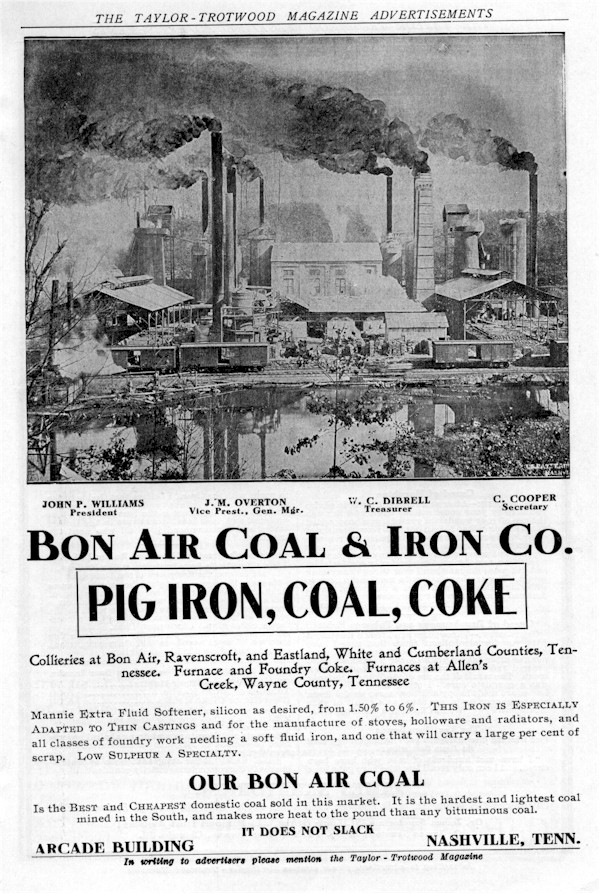
Ad for the Bon Air Coal & Iron Company which appeared in “The Taylor-Trotwood Magazine” February 1907 

The second of the iron furnaces in the upper Buffalo River valley was the Allen’s Creek furnaces. This operation was started in 1891 by the Southern Iron Company as a mining operation. Through the machinations of the Southern Iron Company, the Nashville, Chattanooga and St. Louis Railroad built a trunk line from Shubert in Lewis County, Tennessee to Allens Creek in Wayne County, Tennessee. The main interest at first seems to have been mining ore. But in 1892, construction was begun on two furnaces. These were built from materials and machinery salvaged from two abandoned coke furnaces in west Nashville. Called Mannie #1 and Mannie #2, the #1 furnace was blown in on 22 April 1893.

But before #2 could be brought into blast, the financial panic of 1893 made the company insolvent and operations ceased.19

In 1895, the assets of the Southern Iron Company were bought by the newly established Buffalo Iron Company of Nashville. The new company refurbished Mannie #1 and blew in #2 in 1896.20

During the period from 1892 until 1902, the furnace, when in operation, used charcoal for fuel. At one point, with both #1 and #2 operating, it took two acres of timber a day to furnish charcoal for the furnaces.21 The process was expensive and required many hands to cut the timber, saw it to length for the ovens, fire the ovens and then remove the finished charcoal. A review of the 1900 census for this area reveals that over 50% of the hands were involved in the timber operation.22

In 1902, the Bon Air Coal & Iron Company took over the assets of the Buffalo Iron
Company, which included the assets of the Warner Company in Hickman County, Tennessee.  In exchange for $730,265.94 in preferred capital stock and $730,264.94 in common stock, the Buffalo Iron Company transferred all its assets, contracts, lands and its indebtedness to the Bon Air Coal & Iron Company.23

At this point the furnaces at Allens Creek were changed from charcoal to coke fired furnaces. From an economic standpoint, this was a more profitable arrangement since the Bon Air company owned coal mines at Bon Air, Ravenscroft and Eastland, Tennessee. When necessary they also bought coke from the Virginia coal fields.24
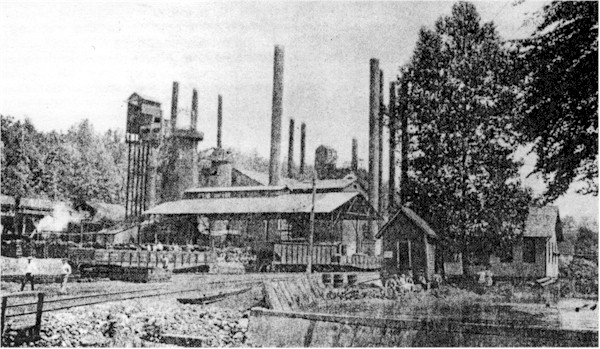
bonair2

The Mannie furnaces at Allens Creek, 1923. Reproduced from the Tennessee Division of Geology Bulletin 39, Plate 29.

Then in 1917, the Bon Air Coal & Iron Company was reorganized as the Bon Air Coral & Iron Corporation with Mr. William J. Wrigley as chairman of the board, James R. Offield, president, Wm. J. Cummins of Nashville as vice-president, John Bowman, treasurer, and Frederick Leare as secretary. Mr. Wrigley, the principal financier in this reorganization was the founder and president/chairman of the board of Wrigley Chewing Gum Company of Chicago. Bowman, president of the Biltmore Hotel chain in New York was the secondary financier.25

Mr. Wrigley’s perception of the problem with the iron industry was summer up in a letter he wrote to J. H. Patrick of Nashville on 5 August 1918:

Some of your descriptions have caused me to laugh for I know how true they are; especially what you say about the Iron Division. First, they are long on coke and short on iron, and then long on coke and iron and short on limestone; then, they are short on all three.26

Because of his sizable investment in the Bon Air operations, Mr. Wrigley made an
inspection tour of the operations in 1917. He arrived by private railroad car in
Collinwood, Tennessee from Nashville, Mr. W. M. Cummins in tow. While in Collinwood, they toured the Bon Air lands and operations west of the town. Then on the second day of the visit, they drove to Waynesboro where Mr. Wrigley delighted the children on the square by passing out free chewing gum. Returning to Collinwood, there was a grand reception in the evening at the Highland Inn, hosted by the Highland Inn Country Club. The following day, the entourage boarded Mr. Wrigley’s private care for a tour of the Allens Creek and
Lyles, Tennessee operations before returning to Nashville.27
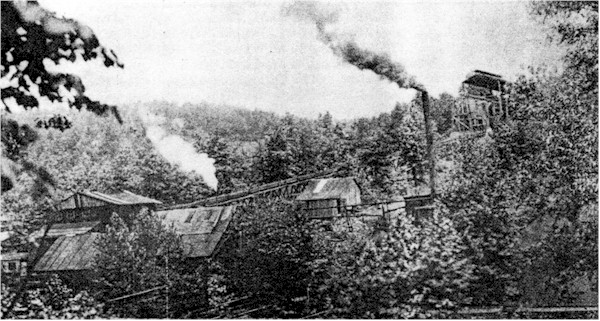
bonair3

Ore washer at the mines of the Bon Air Coal & Iron Corporation, Allens Creek, Lewis County (formerly Wayne County) Tennessee, 1923. Taken from Tennessee Division of Geology Bulletin 39, Plate 28.

The furnaces at Allens Creek continued intermittent operation until 1923. From 1920 to 1923, only one stack was in blast. The company underwent reorganization in 1920. In an attempt to remain competitive, the corporation induced the state legislature to change the county line between Wayne and Lewis Counties so that the Allens Creek operations were placed in Lewis County. This occurred in 1924. But all attempts at revitalization failed; the furnaces were dismantled in 1926 and sold for scrap iron.28

The biggest problem associated with the iron industry in the Buffalo River valley, as well as elsewhere on the Western Highland Rim, was the lack of capital to finance the operations. To build and operate the furnaces required large amounts of money which was not always readily available. Prior to the Civil War, the only means of obtaining this capital was in loans from banking institutions and in partnerships of monied people. The limited liability stock company had not generally come into use prior to the war.

This practice of partnerships and loans was fraught with problems. Frequent financial panics forced calls on loans and often forced the dissolution of the partnerships. Each time the iron works were the first to feel the effects of the panics.

The Civil War practically destroyed the industry in the Western Highland Rim. Prior to the war, much of the labor had been supplied by slaves, usually leased from the planters or their estates. The war and the subsequent emancipation of the slaves, eliminated a pool of cheap labor. Attempts to rebuild following the war were often met with further economic setbacks. The Panic of 1873 for example resulted in a four-year long depression which wiped out most of the operations.

Another problem facing the iron producers in the upper Buffalo River valley was
transportation. Prior to the 1890’s their ores had to be hauled to the furnace or forge site by wagons; the finished product, either pigs or blooms, had to be hauled, again by wagon, to either the railhead at Mt. Pleasant, Tennessee or to the nearest river port, Clifton, Tennessee. The building of the spur lines from Summertown to Napier and from Centerville to Allens Creek eliminated most of the transportation problems. But it was simply too late; by this time, the rich ore fields in Minnesota and Wisconsin had eliminated the need for the poorer quality iron produced at Allens Creek and Napier.

There is little doubt that the iron industry play a significant role in the development of the upper Buffalo River valley. There is also little doubt that financial instability and the availability of higher grade ores spelled doom for the iron industry in the upper Buffalo River valley.

____________________

Footnotes:

1. Phelps, Dawson, “Stands and Travel Accommodations On The Natchez Trace”,
unpublished. manuscript, Natchez Trace Library, Tupelo, MS, p. 53.

2. Carpenter, Viola H., “Some Lawrence County Iron Mongers And Their Mines.” Yesterday
and Today In Lawrence County, [Tennessee]
, Volume VII, Issue 3.

3. Ibid.

4. Ibid.

5. Smith, Samuel D., et al, A Cultural Resource Survey Of Tennessee’s Western
Highland Rim Iron Industry, 1790’s – 1930’s
, Tennessee Department of Conservation,
Division of Archaeology, Research Series #8, 1988, pp. 88-89.

6. Carpenter

7. Ibid.

8. Smith, page 88.

9. Carter, Maymaud & Joan C. Hudgins, 1850 Census of Lawrence County, Tennessee,
page 105.

10. Warren, Polly C., Lawrence County, Tennessee 1840, 1860 Census, Private Acts and
Miscellaneous Newspaper Extracts
, P-Vine Press, n.d., p. 86.

11. Map, Army of the Cumberland, US Army, Corps of Engineers, 1863.

12. Smith, p. 89.

13. Whitney, Henry D., comp., ed., The Land Laws of Tennessee, Chattnooga, J. M.
Deardorff & Sons, 1891, p.954.

14. Smith, p. 89

15. Ibid.

16. Purdue, A. H., The Iron Industry Of Lawrence and Wayne Counties, Tennessee”, The
Resources Of Tennessee
, Volume 2, Number 10, October 1912, pp. 375-376.

17. Smith, p. 89.

18. Purdue, p. 375.

19.Miser,Hugh D., Mineral Resources Of The Waynesboro Quadrangle, Tennessee,
State Geological Survey, Bulletin #26, 1921,p. 46.

20. Ibid.

21. Ibid.

22. Scott, Alf & June, Census Records of Wayne County, Tennessee, Volume
5:1900, pp. 123-148.

23. Buffalo Iron Company to Bon Air Coal & Iron Company, Deed, 5 August 1902, Wayne
County, Tennessee Deed Record, Book Y, pp. 124-215.

24. Miser, p. 46.

25. Wrigley, Wm. F., Jr. private correspondence, Wm. F. Wrigley, Jr. Company Archives,
Chicago, Illinois.

26. Wrigley, Wm. F. Jr. to J. H. Patrick, personal correspondence, 5 August 1918.

27. Lawrenceburg, Tennessee “Democrat”, 17 June 1917.

28. Smith, p. 88.


SOURCES:

Anonymus, “From The Collinwood Pilot,” Democrat, 17 June 1917,
Lawrenceburg, Tennessee.

Carpenter, Viola H., “Some Lawrence County Iron Mongers And Their Mines,” Yesterday
and Today in Lawrence County [Tennessee{
, Volume Vii, Issue 3.

Carter, Marymaud K., & Joan C. Hudgins, 1850 Census of Lawrence County,
Tennessee
, privately printed, Lawrenceburg, Tennessee, n.d.

Miser, Hugh D., Mineral Resources Of The Waynesboro Quadrangle, Tennessee, State
of Tennessee, State Geological Survey, Bulletin 26, Williams, Nashville, 1921.

Phelps, Dawson, “Stands and Travel Accommodations On The Natchez Trace”,
unpublished manuscript, Natchez Trace Parkway Library, Tupelo, MS, n.d.

Purdue, A. H. “The Iron Industry of Lawrence and Wayne Counties, Tennessee,” The
Resources of Tennessee
, Volume 2, Number 10, October 1912. Tennessee Geological
Survey, Nashville, Tennessee.

Scott, Alf & June, Wayne County, Tennessee Census Records, Volume 5: 1900,
The Byler Press, Collinwood, Tennessee 1988.

Smith, Samuel D., Charles P. Stripling, and James M. Brannon, A Cultural Resource
Survey of Tennessee’s Western Highland Rim Iron Industry 1790’s – 1930’s
,
Tennessee Department of Conservation, Division of Archaeology, Research Series #8, 1988.

U.S. Army Corps of Engineers, Map – Army of the Cumberland, 1863, US Archives,
Washington, DC, unpublished.

Warren, Polly C., Lawrence County, Tennessee 1840 Census, 1860 Census, Private Acts,
Miscellaneous Newspaper Abstracts
, P-Vine Press, Columbia, TN, n.d.

Wayne County, Tennessee Deed Records, Book Y, Wayne County Courthouse,
Waynesboro, Tennessee.

Whitney, Henry D., comp., ed. The Land Laws Of Tennessee, Chattanooga, J. M.
Deardorff & Sons, 1891.

Wrigley, William F., Jr., Private Correspondence, William F. Wrigley, Jr. Company
Archives, Chicago, Illinois.