
Current papers
- Herald News of Dayton, TN – website | facebook
- Chattanooga Times Free Press – covers Rhea county news – website | facebook
Historical papers
- Rhea County newspapers – directory listing at Chronicling America.gov website
Current papers
Historical papers
Bettye Jeane Broyles passed away Sunday, March 27, 2011.She was born Aug. 16, 1928, the daughter of Howard Matlock Broyles and Iva Locke Broyles.
 Bettye was a graduate of Red Bank High School and in 1955 graduated from the University of Chattanooga.Following studies in archaeology at Indiana University, she worked as archaeologist at the Illinois State Museum, the Universities of Georgia and North Carolina, the West Virginia Geological Surveys Section of Archaeology and at the University of Mississippi.
Bettye taught classes in archaeology at West Virginia University and was elected a full member of the Society of Sigma Xi, an honorary scientific organization. She published extensively on archeological projects, served in several professional organizations and as editor of the Southeastern Archaeological Conference and editor of the West Virginia Archaeological Society.
Retiring from archaeology in 1987, Bettye returned to Red Bank, Tenn., and began publishing books on Rhea and Meigs County history. She authored or transcribed over 50 publications, served as president of the Rhea County Historical Society for more than 20 years and was named official historian of Rhea County.
Funeral services were at 10 a.m. Thursday at Lane Funeral Home, Ashland Terrace with visitation 9-10 a.m. Thursday.Interment followed in Decatur Cemetery, Decatur, Tenn.
Ms. Betty Broyles was the compiler of History of Rhea County, Tennessee and has written, abstracted or compiled many other books about Rhea County which will be of help to the genealogist and family historian. Look for these books listed elsewhere on this site.
Rhea County is located in East Tennessee, one of the state’s three “grand divisions.” Rhea County was formed in 1807 from Roane County.
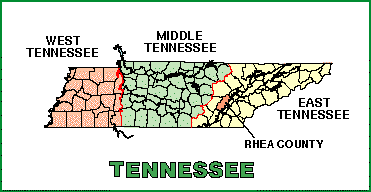
TOPOGRAPHY AND MIGRATION PATTERNS OF RHEA COUNTY
Most early settlers in Rhea County came from eastern seaboard tates (North Carolina, Virginia and South Carolina ) or the counties of upper east Tennessee, namely, Roane, Grainger, Anderson and Knox. Expansion was rapid in the early days of the county.
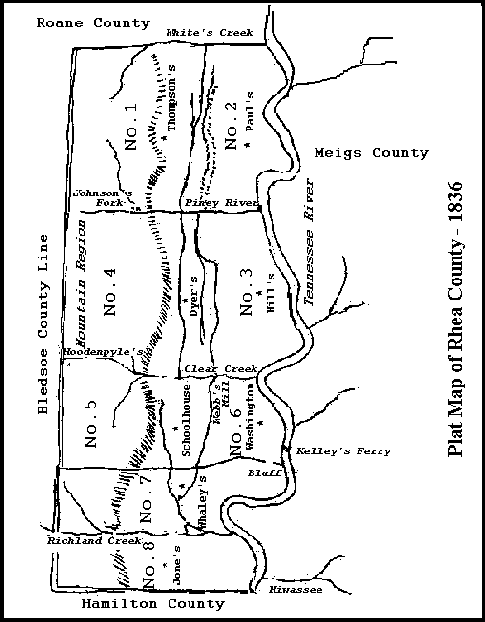
In 1835 Civil Districts were laid off based on voting populations. Steven Winton, Abraham Cox, Jr. and John D. Chattin were appointed Commissioners. In 1836, they were replaced by James McCanse, James A. Darwin and William McDonald.
At this time the population of Rhea county consisted of 692 qualified voters in the 8 newly created districts.
Follow this link for an 1836 Plat Map of Rhea County and the descriptions of the districts and lists of persons whose homes served as the first voting places.
The map below is a re-creation of a Plat Map drawn at the time the 8 original districts were created.
District One
Beginning at the north corner of Rhea County running from thence with the Roane County line to Whites Creek and down Whites Creek to the upper corner of Thomas McKiddy’s land. Thence with his line to the corner. Thence a direct line to the head of Charles Mitchell’s Spring. Thence down his Spring branch to Muddy Creek and down Muddy Creek to Piney River. Thence up Piney River to Johnson’s fork of the same and up said Johnson’s fork to the Bledsoe County line. Thence with said County line to the Beginning. We appoint the place of holding elections in the first district at Jesse Thompson’s.
District Two
Beginning at Thomas McKiddy’s upper corner on Whites Creek. Thence down said Creek to Tennessee River, thence down said River to the mouth of Piney River, thence up Piney River to the mouth of Muddy Creek. Thence up Muddy Creek to the mouth of Charles Mitchell’s Spring Branch. Thence to the head thereof. Thence a direct line to the Beginning. We appoint the place of holding elections in the second district at Archibald D. Paul’s.
District Three
Beginning at the mouth of Piney River, thence up Piney River to the bridge on the middle road. Thence with the Middle road to where Horsby’s ferry road crosses it. Thence a direct line to the nearest summit of the main leading Wolf Creek ridge. Thence with the extreme Height of said ridge to the nearest summit to Clar Creek. Thence a direct line to the mouth of the Cave Spring branch in West’s mill pond on Clear Creek. Thence down Clear Creek with the various meanders thereof to its mouth. Thence up Tennessee River to the Beginning. We appoint the place of holding elections in the third District at John Hill’s.
District Four
Beginning at Piney Piney bridge on the Middle road. Thence with the Middle road to where Hornsby’s ferry road crosses it. Thence a direct line to the nearest summit of the main leading Wolf Creek ridge. Thence with the extreme height of said ridge to its neares Summit to Clear Creek. Thence a direct line to strike Clear Creek at the mouth of the Cave Spring branch in West’s mill pond. Thence up Clear Creek to the head. Thence a direct line to the bridge on Piney River at Beaty’s Turnpike road. Thence with said road to David Hoodenplye’s on the Bledsoe County line. Thence with said County line to Johnson’s fork of Piney and down Johnson’s fork to main Piney River and down Piney River to the Beginning. We appoint the place of holding elections in the fourth district at Spils Be Dyer’s.
District Five
Beginning at David Hoodenpyle’s on the Bledsoe County line, thence with Beaty’s Turnpike road to Piney bridge. Thence a direct line to the head of Clear Creek and down Clear Creek to West’s mill. Thence a direct line to the nearest summit of the main Valley ridge. Thence with the extrreme height of said ridge to a point bearing S 60 degrees E from Samuel Garwood’s, thence a direct line North 60 degrees West intersecting said Garwood’s dwelling house, continuing that course to the Bledsoe County line. Thence with said County line to the Beginning. We appoint the place of holding elections in the fifth district at the School house near Jackson Howerton’s.
District Six
Beginning at the mouth of Clear Creek and running down Tennessee River to the first large bluff above V. A. Gile’s, thence a direct line over the summit of said bluff to Noland’s pond near the Washington road. Thence a direct line to the south corner of district No. 5 on the main valley ridge at a point bearing directly S 60 degrees E from Samuel Garwood’s dwelling house. Thence with the extreme height of said ridge to the nearest Summit to Clear Creek. Thence directly to West’s mill, thence down Clear Creek to the Beginning. We appoint the place of holding elections in the sixth district at the Court House in Washington.
District Seven
Beginning on Tennessee River at the first large bluff above V.A. Gile’s, thence a direct line over the summit of said bluff to Noland’s pond near the Washington road. Thence a direct line to the corner of districts Nos 4 and 6, thence a direct line N 60 degrees W intersecting Samuel Garwoods’s house continuing that course to the Bledsoe County line. Thence with the Bledsoe County line to main Richland Creek. Thence down said Creek to Tennessee River. We appoint the place of holding elections in the seventh district at John Whaley’s.
District Eight
Beginning on Tennessee River at the mouth of Richland Creek. Thence up main or Big Richland creek to the Bledsoe County line. Thence with said line to the North corner of Hamilton County. Thence with the Hamilton County line to Tennessee River. Thence up Tennessee River to the Beginning. We appoint the place of holding elections in the eighth district at the house of B. F. Jones.
In October, 1807 a bill was presented in the Tennessee Legislature to reduce the size of Roane County and create two new counties. The names for the new counties were Bledsoe and Cumberland. At the suggestion of the Grainger County Representative, John Cocke and the Montgomery County Representative, Willie Blount, the name Cumberland was struck out and replaced with Rhea.
The bill was sent to Governor Sevier in November and returned with his signature on December 3rd, 1807.
The original boundaries were changed in 1809 to place the dividing line between Rhea and Roane Counties at White’s Creek. In 1815, a small portion of Rhea County lying north of White’s Creek was returned to Roane County.
“Beginning at White’s Creek near Matthew English’s saw mill, at the mouth of Crab Orchard Creek, thence running up said creek to the mouth of Burke’s Creek, thence a direct course to the new corner of Rhea County, at the line of Overton County, is hereby declared to be and made a part of Roane County.”
In 1817 another Legislative Act enlarged Rhea County and eliminated a large part of present day Hamilton County from Rhea. Other Boundary changes were made in 1817, 1819, 1821, and 1833.
Several legislative acts to change the boundaries for individuals also impacted the county.
ACTS OF 1837-1838 – Changed the Rhea and Roane county line to include Leonard
C. Nance within Roane County.
ACTS OF 1849-1850 – Changed the line between Rhea and Hamilton Counties to
include John Gray and Roman Quarles in Rhea County.
ACTS OF 1859-1860 – Rearranged the line between Rhea and Cumberland County
“so as to embrace all the lands belonging to the estate of Thomas J. Gillespie,
deceased, in Rhea County.”
THE ACTS OF 1867-1868 – Included in Rhea County “the farm of Mrs. Ann
Russell, the farm of the heirs of John Gray, deceased, the farm of Mrs. Nancy
McGill, the farm of Alexander Hickman, and the farm of F.M. Bowers,” all
formerly located in Hamilton County.
ACT OF 1879 – Changed the Rhea-Hamilton line to include the farm of James A.
Kelly in Rhea County.
ACT OF 1881 – Placed the land of James Sladen in Bledsoe County.
ACTS OF 1889 – Moved all the lands and improvements belonging to Oxshee John
Thurman out of Rhea County and into Bledsoe County and the lands of Peter B.
Clouse and Theodore Flora out of Hamilton County and into Rhea.
Check this page later for further descriptions of boundary changes.
IN THE BEGINNING….
The area that is now Rhea County was originally occupied by the Cherokee and ceded by treaty. Large areas of land were also acquired by North Carolina land grants. As early as 1760, Elisha Weldon (Walding, Wallen, Wallins, Walling, Walden) visited the area. In 1768 Thomas Hutchins made a survey of the Tennessee River. Early Rhea County deed books indicate that a group of men made a trip to the Muscle Shoals area in 1783 and may have filed for warrants on the land when they returned to North Carolina.
The Tellico Treaty of 1805 with the Cherokee extended the boundaries to a line due west from the mouth of the Hiwassee River. From 1805 to 1807, the area that is now Rhea County was in Roane County. Before that, it was part of Knox, Hawkins and Sullivan Counties. Most of the North Carolina land grants were in the area previously known as Hawkins County.
In 1803 and 1806, the Hiwassee and Sail Creek Indian schools were established by the Reverend Gideon Blackburn, followed closely by the building of the Hiwassee Garrison and Indian Agency which was managed by the Indian Agent, Return J. Meigs. An 1809 List of Officers and Regulars in Captain Thomas J. VanDyke’s Company has survived the ravages of time and gives us the names of early immigrants to the area. In 1816 the garrison was moved to a new site due to a conflict over the ownership of the land. Charles McClung filed a suit against Meigs claiming that he had purchased the land in 1807 from John Donelson (who had been granted the land by North Carolina in 1788).
As in other counties, much of the land acquired by early settlers was a result of laws passed by the Tennessee State Legislature 1806-1809 which allowed a settler to claim the land he was living on as well as other unclaimed lands. To learn the names of some of these early settlers, look at the 1808 Tax list.
After the county was formed in 1807, many small boundary changes continued to be made. These changes returned a small portion of Rhea to Roane in 1815. Other changes were made between Rhea and Bledsoe (1821), Hamilton (1821 and 1833), and McMinn (1833). In some cases, Legislative acts changed boundary lines to accommodate citizens with land in two counties. In 1836 Meigs County was created from Rhea.
Research in early Rhea County can involve the counties of Roane, Knox, Hawkins, Sullivan, Bledsoe, Hamilton, Meigs and McMinn.
Date Event
1783 First settlers claim North Carolina land grants.
1796 Tennessee becomes the 16th state.
1801 Roane County, which contained most of Rhea is created.
1805 Tellico Treaty - Cherokee Nation surrenders claims to additional land.
1806 Return J. Meigs lays out the site of the Hiwassee Garrison and Indian Agency.
1807 Rhea County established.
1808 John McClellan surveys land for 72 individuals. 112 are listed on tax list.
1811 Land is laid off for the town of Washington. Courthouse and jail planned.
1812 WAR OF 1812
1814 Stocks and pillory built.
1830 New Courthouse is built.
1836 Meigs County created from Rhea.
1847 Flood devastates town of Washington.
1861 CIVIL WAR. Rhea County forms home guard. Tennessee secedes from the Union, and joins the Confederate States of America.
1866 Tennessee re-admitted to the Union. Many Rhea citizens relocate.
1899 County seat moved to Dayton.



 Facebook
  Instagram
  Substack
  Youtube
  Pinterest
  Email Newsletter
  Subscribe with Feedly
  Subscribe with RSS reader