
Rockwood Mine’s Deadly Gas Explosion in 1926

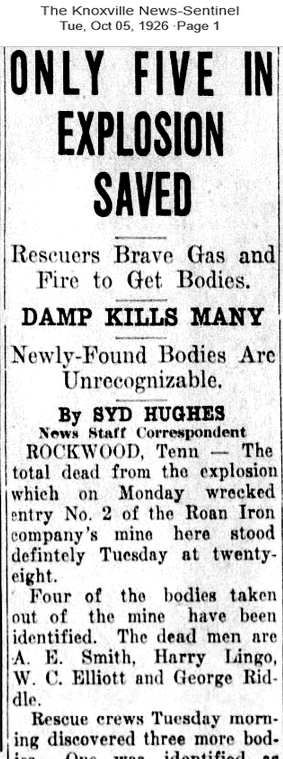
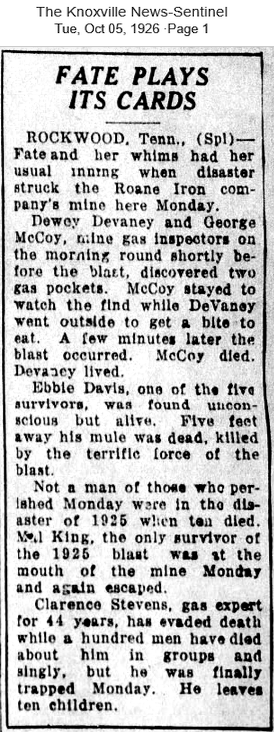
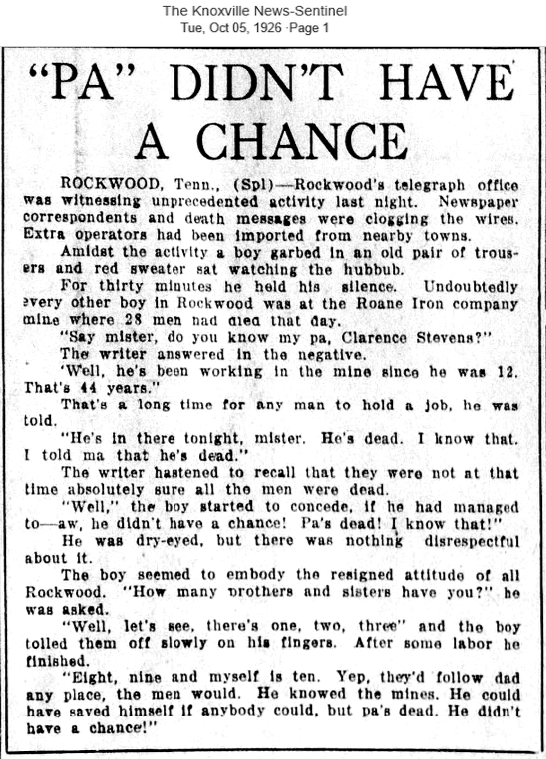
Click thumbnails to view larger images.
Click the links below to view full articles free at Newspapers.com
- “Pa Didn’t Have a Chance” (Clarence Stevens’ son)
- “Fate Plays Its Cards”
- “Only Five in Explosion Saved”
(from the archived TN News Project Web site)
Contributed by Stan Kelley
The Rockwood Times – October 4, 1926
FEAR 32 MINERS DEAD (headline)
RODGERS ENTRY CLAIMS VICTIMS IN NEW BLAST
Rescue Party Enters Mines at 12:15 First News Is Received
(Mouth of mines, 12:30 p.m.) At 12:15 a large rescue party, equipped with oxygen helmets and other rescue equipment, left the mine mouth for Rodgers Entry on a trip of cars. First word of the disaster has been sent to the surface from a party composed of W. C. Wright, Hobart Rogers and Mal King, the latter the sole survivor of the 1925 disaster, who penetrated as far as the hoist engine at the mouth of Bryson dip, of which Rodgers entry is part.
Here they found the hoist engineer, Ebbie Davis, knocked unconscious and a mule dead from the force of the blast. Davis is being brought to the surface, where doctors and ambulances are waiting. A veteran miner told The Times reporter that it will probably be a matter of several hours before the men in Rodgers entry are reached, as there is a large quantity of after damp gas present, against which it will be necessary to brattice.
As the rescue party left, a second party of open lamp men was being recruited to work behind the gas zone when it became necessary to bring out the bodies. Rockwood Avenue in the vicinity of the Roane Iron plant is choked with parked automobiles and the large crowds, and the road to the mines has been roped off and is being guarded by city police, while near the mine mouth a second rope is being guarded by officer W. S. Edde.
All men in other parts of the mine are reported as safe, though they had not all come out at 12:30. The Knoxville and LaFollette rescue crews have been telephoned for and are enroute to aid the local party. It is thought that it will be several hours before the scene of the explosion can be reached.
Thirty-two miners are though to be dead in Rodgers entry of the Roane Iron company coal mines, following a terrific explosion that swept this part of the mines at 9:00 this morning with a force said to exceed that of the explosion that took 12 lives in July, 1925. The first man to discover the disaster was Eugene Tedder, veteran miner, who was knocked down by the force of the blast at the door of his room, two miles from the scene. The explosion is thought to have been caused by a gas blast igniting the coal dust in the entry, which was said to have been exceedingly dry and dusty.
Another report reached the surface that a trip of cars on No. 2 main entry had been blown off the track by the force of the blast. News of the disaster first reached the surface at about 10:30. A large crowd gathered at the mine mouth soon after the news spread over the city, and the Roane Iron company and mine offices were kept busy answering telephone calls from those fearing for the safety of their loved ones in the mines.
First reports placed the number of men in the explosion area at 67, but careful check by mine executives place the number at 32. They are as follows:
- Will Rodgers
- H. M. Griffis
- A. J. Griffis
- Ben Gibson
- Sam Taylor
- Lee Jolly
- Ira Nelson
- Van Kirby
- Elmer Lewis
- P. C. Craven
- S. P. Whittier
- Harry Lingo
- Will Teague
- Arthur Teague
- W. C. Elliot
- E. G. Boles
- C. B. Davis
- Ebbie Davis
- Clarence Stevens
- Phillip Galyon
- Jess Dale
- Walter Cunningham
- E. G. Smith
- Clyde Teague
- Will Armour
- Frank Boles
- Hector Smith
- J. A. Freels
- G. C. McCoy
- Frank Hinds
- Dave Brummett
- Tom Rodgers
Veteran miners and other mine rescue experts at the mine mouth assert that there is practically no hope for the entombed men, and the mine official who gave The Times the list of names read them with a voice shaked [sic] with emotion and sadness, as many had been his friends for years.
The Rockwood Times – October 7, 1926
THIRTEEN BODIES REMOVED FROM MINE
SEWELL WHITTIER FOUND BEHIND PILE OF COAL
— Many Funerals Yesterday and Today 14 Bodies Remain in Entry Fire Not Encountered —
The body of S. P. Whittier was found this morning about 10:00 o’clock by helmet men behind a pile of coal in his room off Rodgers entry and was brought to the surface at 2:00 this afternoon. A search of Whittier‘s place last night failed to disclose the body, which was entirely concealed and which was finally traced from its odor. It is said that the body was not badly torn or mangled.
Twelve bodies have been brought to the surface, four men brought out alive, and 15 more bodies are being sought today by rescue parties following a disastrous explosion which occurred Monday morning about 9:00 oclock in the Rodgers entry, off No. 2 entry of the Roane Iron company coal mines.
News of the disaster was brought to the surface by Eugene Tedder, who was knocked down by the force of the explosion while working in a room two miles distant, and caused great excitement in the city. The first report was that 65 men were in the entry, while a subsequent check of names at the Roane Iron company office reduced the list to 32, the final list showing 31 names.
A large crowd gathered at the mouth of the mines soon after news was received at the surface between 10:30 and 11:00 o’clock, and local policemen and American Legion members were station to guard the roped off areas that was soon established. No cars were allowed to take the road to the mines without a pass.
The first newspaper accounts of the explosion were contained in two extra editions of The Times, one of which was on the streets at 1:30 Monday afternoon with a list of the entombed men and an account of the sending of the first rescue party. The second extra was off the press shortly before 6:00 o’clock with a report of the rescue of Ebbie Davis, E. G. Boles, Will Teague, and Arthur Teague, all alive, and the finding of the body of W. C. Elliot. The Times extras had a sale of 1,000 copies and many more were call for after the editions were exhausted.
The first rescue party, which went in about noon Monday, was led by deputy state mine inspector A. J. Holden, who happened to be visiting relatives in the city that morning enroute to Coal Creek, and superintendent N. D. Wilson. Other members of this party were Nelse Dale, Windle Holden, Arthur McNally, John Riddle, Bill Hardin and John Millican.
This party went down Rodgers entry, which turns off to the left, and others found the body of W. C. Elliot, later coming upon E. G. Boles, lying on the floor of the entry, overcome by after damp but still living. Behind a brattice they found Will Teague and Arthur Teague, alive and unhurt. The Teagues had heard the explosion, which occurred about 3/4 of a mile from where they were working, and immediately erected a brattice which saved their lives. They had later heard both Boles and Elliott struggling in the deadly gas, and had tried to carry Boles to safety but were to weak to complete their journey with him and were forced to let him go.
The first of the explosion victims to be brought out was Ebbie Davis, a hoist engineer stationed about a mile from the explosion, who was carried out unconscious after being found by Hobart Rodgers and Bill Johnson, who heard the blast and, without helmets, reached as far as the hoist before the approach of after damp forced them back. Davis soon recovered and was back at the mine mouth Tuesday morning. A mule on the track near him was killed by the explosion’s force, and the escaping miner remembers nothing except that he was knocked unconscious by the blast and regained consciousness on the outside.
Tuesday morning on the outside, first bodies were brought to the surface, being those of W. C. Elliott and George Riddle. Despite the lateness of the hour, a crowd of some 200 people was present when the main trip bearing the exhausted rescue party and the two bodies reached the surface. Another party immediately went in, and at 4:40 Tuesday morning the trip brought up two mutilated, blackened forms which were first identified as the remains of Harry Lingo and E. G. Smith. The latter body was afterwards identified as Clyde Teague, the identity being established by his mother by means of his teeth and certain scars on his body.
The first bodies to be removed in daylight were those of Clarence Stevens and Philip Galyon, his laborer, reaching the surface Tuesday afternoon. The position of Stevens‘ body indicated that he had crawled from 4,000 to 5,000 feet up Stevens entry — where he had worked for many years — and was within 200 feet of Bryson Dip and fresh air when the deadly after damp, which kills all who survive the force of an explosion, overcame him and he gave up his fight. Neither of these bodies was mangled, and friends who viewed Stevens‘ remains after he was removed to his home on Kingston Ave., Tuesday afternoon say that he appeared as one who had died a natural death or simply fallen asleep.
The next trip that proved to be an underground funeral train was one which came out at 5:00 o’clock Wednesday afternoon with three torn bodies, black as the coal in which they were found — the first to come from the actual explosion area a few hundred feet from the force of Rodgers entry. After some doubt, they were identified as J. A. Freels, Frank Boles, Walter Cunningham, and C. B. Davis.
The 15 bodies still unlocated as the second night rescue party came out at 7:00 this morning are those of Will Rodgers. H. M. Griffis, A. J. Griffis, Sam Taylor, Lee Jolly, Ira Nelson, Van Kirby, P. C. Crave, Frank Hinds, Dave Brummitt, G. C. McCoy, Will Armour, E. G. Smith, Ben Gibson and S. P. Whittier.
The party coming out this morning reported that they had entered Whittier‘s working place and found a heavy fall of coal, which it is feared may cover his body. A shovel had been blown into a tie of the track with such force that it could not be pulled out, and a car of coal in the room coked by the intense heat, they said.
Funerals for four of the 12 recovered dead were held yesterday, while two others are set for today and one tomorrow. No other funeral arrangements had been announced this morning.
The funeral of Clyde Teague was held yesterday morning at 10:00 o’clock, with Rev. R. L. Evans officiating, and funeral services were held yesterday morning at Westel for Harry Lingo.
Yesterday afternoon at 2:00 o’clock funeral services were held for George Riddle, and the funeral of W. C. (Billy) Elliott was held at 2:30 at the residence on Ridge Ave., with members of the Knights of Pythias lodge in charge of the services. Young Elliott was an officer in the local lodge, Oak Leaf No. 49.
The funeral of Phillip Galyon was held this morning at 10:00 at the Galyon home in Clymerville, with Rev. J. C. Orr officiating.
The funeral of Clarence Stevens will be held at 2:00 this aternoon at the Christian church.
Funeral services for J. A. Freels will be held at Graysville tomorrow, the body having been taken there today.
The funeral of Frank Boles will be held this afternoon at 1:00 at the home on Strang St., and funeral services for Walter Cunningham at 10:00 Friday morning at the home at Eureka.
Immediately after news of the disaster was received by Roane Iron company officials on the outside, call[s] for help were sent to other places, the first to arrive being the LaFollette rescue team composed of W. E. Hendren, D. B. Long, J. P. Cox, J. R. Miller, Clay Cupp, Tom Snyder, Elmer Hardin and Jake Henley, who came by motor-truck arriving at 7:00 Monday evening and going in with the next rescue party after that hour.
Soon afterwards, mine rescue car No. 10 of the United States bureau of mines, from Washington, D.C. reached the city after a hasty run behind a special engine from Westbourne, Tenn., where the car had been stationed since Saturday giving rescue training to miners there. C. P. Dempsey, of the bureau of mines, was in charge of the car, which also brought Sam Jones, colored, of Washington, and three picked rescue men from the Westbourne mines — G. R. Randolph, Wm. Hamilton and Char. Little. The car was brought over the L&N to Harriman and there switched to the Southern, brought to Rockwood and taken by a company engine to a track near the mines.
At about 2:30 Tuesday morning a party of mine rescue experts from Birmingham, Ala., including several who saw service in the local mine at the time of the first Rodgers entry explosion in July, 1925, and the rescue of the last bodies in October of the same year, arrived to aid in the work of clearing the entry and recovering the bodies. The Alabama party consisted of F. E. Cash, C. E. Saxon, and Dr. F. E. Merryweather, a recognized authority on coal dust and dust explosions, all of the U.S. Bureau of mines, and W. T. White, of the Du Pont powder company, L. Standifer, of the Kholer company, and John Theiss of the Mine Safety Appliance company.
Geo. Toms, deputy state mine inspector, heard of the disaster while at Dunlap Monday afternoon, and at once set out for Rockwood, arriving Monday night, while chief state mine inspector O. P. Pile arrived Tuesday morning. E. O. Wells, President of the Roane Iron company, arrived on the 6:12 train from Chattanooga Monday evening, going at once to the mines. General superintendent Howard Howie was in New York at the time of the disaster and did not reach Rockwood till yesterday morning. since that time he has been on duty almost continuously at the mines.
The Associated Press cut in a special wire at the telephone exchange late Monday night, over which a special operator sent dispatches for an A.P. staff man. The International News Service had a special correspondent here, as did the Chattanooga Times and News and the Nashville Banner, the latter paper also sending its staff photographer who made a number of flashlight photographs about the mine mouth early Tuesday morning.
Tens of thousands of words of press messages were sent out, special operators being on duty at the Western Union office, while both the telegraph office and telephone exchange were kept busy handling sad messages to relatives of the explosion victims.
Six men who regularly work in Rodgers entry owe their lives to the fact that for various reasons they “laid out,” as miners term an absence from work, on Monday. They are Elmer Lewis, Dewey DeVaney, Clabe Green, Ellis Little, Orville Farmer and Tom Rodgers. The names of both Rodgers and Lewis were on the first lists given out as being in the explosion.
The first open face men, without helmets but with safety lamps, to go into the explosion area as the helmet crews worked ahead and started the circulation of air to displace the after damp were two crews entering Monday night. The first, led by Mal King, sole survivor of the 1925 Rodgers entry explosion, consisted of Carl Monday, Tom True, Dewey DeVaney, Lome Knox, O. T. Summers, A. J. Carroll, Nathan Howard, J. Tom Dannel, Will Durham, Earl Johnson, Gener [sic] Walker, Walter Snow, Bill Johnson, Buck Mitchell and Jim Mitchell.
The were followed at 8:00 p.m., by a party headed by W. H. Elliott, consisting of Henry Hardin, W. C. Taylor, Jess Nance, Arnold Gibson, Herbert Leffew, Frank Lawson, Ben Cunningham, Clarence Falden, Luther Brandon, Pat Hinds, Riley Long, Clyde Oody and L. B. Snow.
These and a number of others whose names The Times has not obtained as yet have since been doing heroic work day and night, with their lives almost constantly in danger. Men who come out with one party are ready to go in with another after snatching a few hours’ sleep, and several have slept around the wash house and office instead of going home, in order to be ready at any time they were needed.
There were rumors Tuesday morning that fire had been encountered as the helmet men and their open face crews slowly forced the air into the chamber of death shown on the mine map as Rodgers entry, but this was not confirmed by later developments, and this morning it was not thought that fire would be found in the remaining territory that must be explored and cleared before the bodies are found. The explosion generated such intense heat, however, that rescue parties found the steel rails and copper signal wires too hot to touch, and only the total absence of oxygen in the poisonous air prevented fire from breaking out. As the air was forced down the entry, it was necessary to spray with chemical extinguishers in order to prevent its being accompanied by fire.
No official statement as to the cause of the disaster has been issued by state mine inspectors or company officials pending the recovery of all bodies bodies and clearing of the entry, but it is said by expert miners that it must have been caused by a gas explosion that ignited and exploded the coal dust in the air. One theory is that some old workings had been struck shortly before the disaster, allowing gas to flow in and forming a highly explosive mixture. The entry was tested for gas Monday morning and found to be in better condition than it had been for two or three weeks.
The list of dead, with the family left by each as given The Times at the company office, is as follows:
- Will Rodgers, married, 5 children
- H. M. Griffis, married, 4 children
- A. J. Griffin [sic; should be Griffis], single
- Ben Gibson, single
- Sam Taylor, married, 3 children
- Lee Jolly, married, several children
- Ira Nelson, single
- Van Kirby, married, 4 children
- P. C. Craven, married, 2 grown children
- S. P. Whittier, married, 6 children
- Harry Lingo, married
- Will Teague, married, 7 children
- Arthur Teague, married, 5 children
- W. C. Elliot, single
- C. B. Davis, married, 1 child
- C. C. Stevens, married, 10 children
- Philip Galyon, married
- Jess Dale, married
- Walter Cunningham, married, 2 children
- E. G. Smith, married, 1 child (is son-in-law of Will Rodgers)
- Clyde Teague, single, son of Will Teague
- Will Armour, single
- Frank Boles, single
- Hector Smith, single
- J. A. Freels, married, 4 children
- G. C. McCoy, married
- Frank Hinds, married, 3 children
- Dave Brummett, married, 6 children
- George Riddle, married, 6 children
It is estimated that the disaster will cost the Roane Iron company between $50,000 and $60,000 in workmen’s compensation payments to the families of the dead miners.