
Technical Engineering Consultants, PC made a site visit on July 3, 1997, to the Historic Roane County Courthouse, Kingston, Tennessee for the purpose of reviewing the one hundred forty year old plus structure. This structural report is the result of a cursory review for the building constructed in 1853 with a thorough visual inspection of obvious structural problem areas and a representative inspection of the remaining structural conditions. Photographs were taken in areas of structural problems or concerns and have been labeled and included with this report for quick reference and identification.
A. Cupola
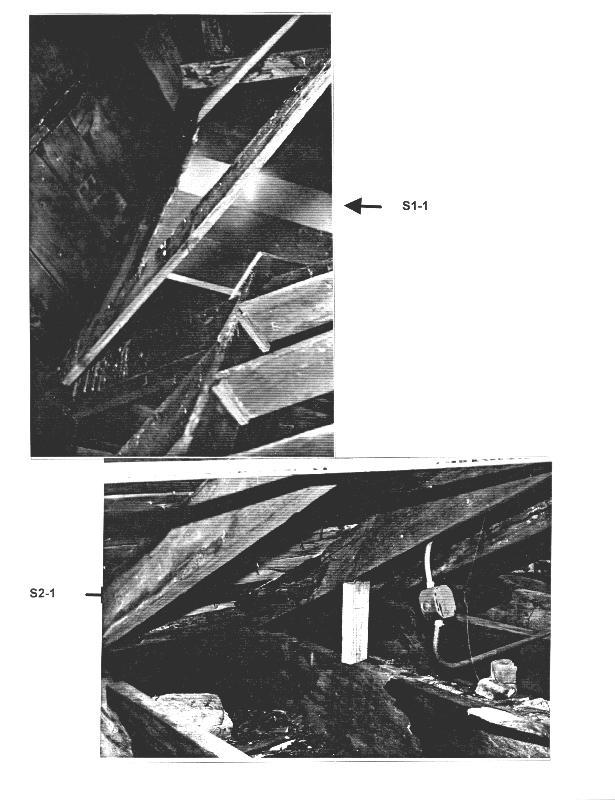
A1: The wood roof deck on four sides of the eight sided framing has been removed and replaced with metal panels (Photograph S1-l).
A2: Hip roof framing behind the cupola base displayed signs of past water problems and a new knee wall to support the rafters off of the ceiling joists. If the ceiling joists are adequate for the load transfer, additional repairs are not required. However, creep from the additional load may cause the ceiling joists to experience permanent deformation. Sistered rafters to the existing roof rafters would remove any additional load from the ceiling joists as well as provide the strength required for the roof loads.
B. Records Attic
B1: The courtroom ceiling framing in the unfloored areas of the attic span long distances with the compression edge unbraced (S2-1). Creep from dead loads for the 140 year old framing has caused the members to roll and/or buckle. Strip bracing or flooring would provide the necessary system to prevent future movement.
B2: The floor deck is missing in several small areas, possibly from past inspections and water damage (S2-2). The remaining floor displayed minor buckling from expansion of the material as a result of moisture.
B3: Two, double 2 x 10 beams have been constructed along the attic floor, between the two pairs of original support columns for the cupola. The beams are separated the width of the original columns and appear to be bearing on three heavy timber members running perpendicular to the beams and the floor joists of the attic floor framing. The beams support two posts, located approximately at third points along the beam. The posts bear on wood plates which span between the plys of the beam. The posts on the east side are solid single members that connect to a plywood plate at the ceiling of the room (S2-3). The posts on the west side have additional plywood with 2x members attached and support a wood beam at the ceiling which runs parallel to the double 2 x 10 beams below (S2-4). The double 2 x 10 beams are spliced with short plywood plates on each side of each ply near the original columns on the south side. The double 2 x 10 beams display a deflected shape as a result of the post loads or the poor splice plate connection or a combination of the two. While the original columns do not bear directly over the main building columns below, we did not observe any visible signs of overstress from the column loads on the original support beams in the framing above the courtroom. For restoration, the floor and ceiling framing should be exposed for a full review of past movement and damage. If the review is favorable, new framing can be provided above ceiling and below the flooring allowing the finishes of the room to be restored to the original condition.
B4; In two areas where the flooring had been removed, the connection of the floor joists, spanning north-south between the interior building columns, have been exposed. The double notched ends of the floor joists are fully exposed with no contact to the supporting beam indicating significant movement of several inches (S2-5). Members have been sistered onto one side of the joists and nailed to vertical plates that have been nailed to the original beams. Additional movement has occurred since this repair was installed. This conditional is extremely dangerous with the possibility of collapse. For immediate temporary repairs, metal joist hangers or straps should be installed and connected to the original beam. This condition appears to have existed for a long period of time even to the point that the courtroom ceiling may have been repaired to conceal the movement. There does not appear to be any signs of recent movement. Depending upon the extent of restoration, this framing could possibly be reconnected. Most of the court room ceiling and the records attic flooring would need to be removed to allow the entire upper structure to shift. This repair would be expensive because of the labor and time involved as well as bracing the adjacent structural framing during the repair. An alternate repair would allow the existing framing to remain in its present state requiring less finish work repairs to the courtroom ceiling. Full length members would be sistered to one or both sides of the original joists allowing full depth members to be supported by new metal beam hangers at the original wood beam. This repair would also require most of the attic flooring to be removed.
B5: The floor joists on the outside bays of the interior columns appear to span from the interior beam line to the exterior brick walls (it is not known at this time if these joists are also separated at the interior beams). The joist bear on small wood plates at the brick wall (S2-6) and extend over the wall to support the roof rafters. While we did not observe any positive connection of the joists to the wall, we did notice structural steel straps with steel rods and turnbuckles extending to a steel angle that has been strapped to the ceiling joists of the porches on the north and south sides (S2-7). The design of the straps appear to be for the support of the porch framing instead of anchorage for the attic floor and main roof framing. This also requires the brick wall to be supported laterally by the friction of the wood framing on top of the wall only. Since the walls are constructed of multi-wythe brick (which has very little continuity) gauge metal anchor plates may provide the necessary connection requirements for load transfer. These joists are also the members mentioned in Item B1.
B6: The north and south porch framing appear to have been constructed to be cantilevered instead of bearing on the 24″ diameter hollow wood columns. The steel straps, rods and angles in Item B5 appear to have been added to provide support for possible sagging in the ceiling & roof framing of the porch. Some of the steel rods were loose and may need a few turns of the turnbuckle to provide the support for the framing.
B7: The mortar in the chimneys and wall of the expose areas in the attic were showing signs of decay with several loose brick.
C. Courtroom
C1: Water damage was observed in northeast and southeast corners and beside the fireplaces on the north and south walls of the courtroom. The damage on the south side appeared to be the most severe with decay and cracks in the plaster finish as well as the brick walls and mortar (S3-1).
C2: The cracks in the wall around the window on the south wail nearest the east corner are visible on the interior (S3-2 & S3-3) and exterior (S3-4) face and displays signs of past repair work. According to The History of the Historic Roane County Courthouse (HHRCC) the north and east exterior walls were rebuilt in 1892 resulting from the fact that the multiple wythes of the exterior walls were not connected or joined at any of the courses. Renovations in 1976 also repaired cracks in the brick wall but in the outer layer only. The HHRCC also mentions that steel rods were added in the 1892 repairs to stabilize the walls. The rods were visible in two locations inside the courtroom near the ceiling (S3-5 & S3-6) and from the exterior, appear to be below the courtroom floor framing. The rods appear to have stopped the movement of the brick in the areas localized around the rods or the 1892 repairs may have attempted to realign the outer wythe by tightening the rods beyond snug which may have only corrected the brick in area local to the rod plates on the exterior of the wall (S3-4). In either case, the exterior face of the wall displays a wave appearance (S3-7). However, our view from ground level did not reveal any signs of significant movement in the recent times. Due to the height each wythe is required to span, long term renovation will need to incorporate more uniform bracing than the rods can provide.
Connecting the wythes by mechanical or chemical methods could allow most of the wall to remain in place and replacing only the damaged brick and decayed mortar. Bonding or anchoring the wythes together will create a wider wall and reduce the slenderness ration buckling failure problem experienced by the individual wythes.
C3: Settlement appears to have been a problem in the southeast corner as evident by the cracks in the brick wall (S3-9 &S3-10) and the sloped window frames (S3-8) on the east and south walls near the corner. This area displays the most moisture damage from roof leaks which may be the cause of the settlement. The chimney for the boiler in the 1936 addition is near this area and it also contains a great amount of past moisture problems. At the time of our visit, the walls appeared dry and no signs of recent movement was observed.
D. Main Level
D1: A review of the main level did not reveal any visible damage. This level appears to be maintained and occupied throughout the year. There was not access to the crawlspace for a review of the main level floor framing. Small holes have been made for mechanical ducts at the basement below the 1936 addition.
E. Exterior
E1: The concrete slabs for the north and south porches show signs of past settlement problems (S5-1). No signs of recent movement were observed.
E2: Although the 24″ diameter columns may not support the porch roof framing, photographs taken during the 1976 renovation indicate the columns do support the balcony framing. The finished ceiling of the balcony (S5-2) and roof (S5-3) on the south porch displayed severe signs of member decay and failure at the columns. The north porch balcony was repaired in 1976 but is currently experiencing damage to the finishes and possibly the structural members (S5-4). All of the 24″ diameter columns are or have experienced moderate to severe decay (S5-5 & S5-6).
E3: The limestone steps on the south (S5-6) and west (S5-7) porches contain several cracks and are misaligned. These areas can be easily removed, cleaned and reset.
E4: Severe decay in trim work at the eave in the corner of the north interface between the 1936 addition and the original courthouse (S5-8).
E5: A form board along the building in a renovated sidewalk on the east side of the north porch has decayed and is allowing water to penetrate into the foundation area (S5-9).
E6: Mortar, in the brick joints along the ground and in areas where water problems have occurred, is loose, missing or decayed (S5-10). These joints should be cleaned and pointed.
The overall settlement observed for the 140 year old plus structure is minimal especially considering the foundation may be a non-continuous system constructed of large sections of limestone. Also the fact that moisture has attacked this building for many years and in several areas moisture is still a major problem, makes the relatively minor settlement problems even more amazing. Once all of the moisture is removed from the soil below the walls, additional settlement may occur as the soil consolidates to fill any voids left by the water. The overall condition of the wood material is good. Some of the movement has left the structure in an existing poor condition, but with the remaining good material to work with, repairs can greatly improve the structural integrity of the building. The unfortunate area in the structural condition of the building was the use of independent wythes for brick wall construction. As previously stated, the walls appear to be at equilibrium with no signs of recent movement. However, several factors regarding the overall stability in the structure include damage in the brick and mortar from the moisture, the concentrated loads at the stabilizing rods, the amount of eccentricity from the load in the already buckled wall areas and the possibility of soft clay brick on the interior wythes. The damage from lateral forces such as wind and seismic would be the most detrimental, simply because the walls have limited ability to transfer loads successfully between the different wythes. Although retrofitting may not increase the walls’ ability to resist a major earthquake, it will greatly improve the capacity and strength against time and normal to moderate loading conditions.