
Rockwood Living History Reenactment
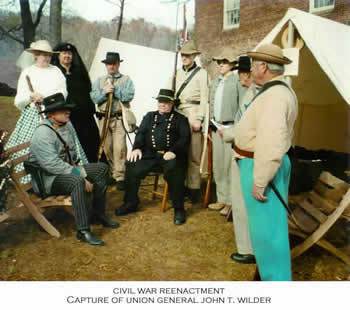
(from the archived Rockwood 2000 Web site about 2006)
Photo caption: Christmas Reenactment – these living history reenactments are usually performed annually during the Christmas Homes Tour.
Background: Circa 1862, the Confederate Army successfully mounted a campaign using cavalry troops supplemented by guerillas against the Union Army’s western theater of operations, which included Tennessee. The Union was hampered by the lack of a correlating number of cavalry soldiers, requiring some ingenuity and resourcefulness. Unsuccessful attempts were made to thwart the Confederate cavalry by deploying infantry in trucks and using units who rode mules. General William S. Rosencrans was the commander of the Army of the Cumberland.
John T. Wilder was the commander of the 17th Indiana Volunteer Infantry Regiment. General Wilder was formerly a citizen who entered the Army with no prior military expertise. He became a tactician by self study. Wilder proposed to provide mounts for his infantry and give them better, lighter weapons. His weapon of choice was the seven shot Spencer repeating rifle. General Rosencrans approved this proposal.
Initially, Wilder had difficulty obtaining the weapons through the normal channels of acquisition from the Ordnance Department. So convinced that these weapons were integral to the war, Wilder offered to purchase enough weapons for his brigade, or to cosign loans for his soldiers from an Indiana Bank. Eventually, the War Department assumed the cost of the weapons, and the horses were acquired by capture and conscription.
Thusly armed, Wilder‘s brigade went on to successful engagements including Chickamauga, Hoover’s Gap, the Selma Expedition, and they were a part of the capture of Chattanooga. This brigade was able to move so fast while producing an amazing amount of firepower, that Confederate soldiers often thought they were battling a division rather than a single brigade. Wilder‘s brigade became renowned as the “Lightning Brigade.”
©2005, Rockwood 2000. This website made possible by a gift from Marion Unterweger.