
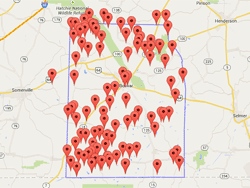
We learn that the friends of the proposed new county, which is to be composed of portions of McNairy, Hardeman and Fayette are untiring in their exertions, and that a map of the survey, recently made, has been drawn, and that parties have left for Nashville for the purpose of getting a bill passed by the Legislature allowing a vote to be taken on the question. As to the success of the movement “honors are easy.” Of course the Legislature will aid the project, as the new county will be hugely loyal. It will be an easy matter for the originators of the project to control the negro vote within the proposed bounds.

As far as Hardeman is concerned; while in McNairy, there will be no trouble in polling a majority vote for the new county, as there is a large number of persons living along the line of the Memphis and Charleston railroad who wish to pass from under the rule of Fielding Hurst. As to Fayette, the chances are a little gloomy; if LaGrange is to be the county site, all right; but if Grand Junction is to have the court house, a “dead mackerel will be seen as well as smelt.” According to the map, and we learn that it is a very neat one in appearance, the whole thing is “mighty nice” one way by powerful funny the other. For instance: The east boundary of the new county is to be in the neighborhood of Big Hill, on the M. & C. R. R., while the western line will join Shelby county – sixty miles away!

This is the nice part of the programme. North and south, the county, should it be formed, will be from four to seven miles wide! This is the funny part of a big thing on ice. Taking it for granted that Grand Junction, the center of the strip, is made the county site, persons attending court will have to travel thirty miles to attend court, provided they live in the east or west end of the county, while those living near the south or north line of the county will not have to go more than two and a half or three miles. To us, this seems to be the most ill-shapen plat for a county within this or any other State, and the inequality of its proportions should kill the proposition if there were no other reasons.

The way the arrangement is to be put through is somewhat dusky. In conversation one of the strongest advocates of the new county said that he thought the whites of Hardeman would, as a majority, vote against the measure, but that the lately enfranchised – negros – could be used! Here, then, is the programme. Irresponsible, ignorant negroes are to vote white men, tax payers out of the county they were born in! Should the county be formed, its northern boundary will be just thirteen miles south of Bolivar and twelve miles south of Somerville, and as a consequence will reduce Hardeman to less than 625 square miles, which cannot be done without violation of law.

The Bolivar bulletin. (Bolivar, Hardeman County, Tenn.), 09 Nov, Page 2. 1867. Chronicling America: Historic American Newspapers. Lib. of Congress.

In 1860, as shown by the census reports, there were sixty-four persons (white) in the State of Tennessee over 100 years of age.

The Bolivar bulletin. (Bolivar, Hardeman County, Tenn.), 02 Nov. 1867, Page 4. Chronicling America: Historic American Newspapers. Lib. of Congress.

A destructive fire occurred in LaGrange on last Friday night one week ago, by which property to the amount of $6,000 was consumed. The fire, as we learn originated in the premises occupied by a Mr. SIMMONS. The buildings destroyed, three in number, were owned by Mr. Frank COSSITT. Loss partially covered by insurance.

The Bolivar bulletin. (Bolivar, Hardeman County, Tenn.), 02 Nov. 1867, Page 4. Chronicling America: Historic American Newspapers. Lib. of Congress.

This popular school, lately presided over by Mrs. W. H. THOMPSON and Miss SAFFORD, has passed under the control of Mrs. William E. GLOVER and Mrs. William MONTGOMERY, by reason of the fact that Mrs. THOMPSON goes to join her family at Columbus, while Miss SAFFORD, as we learn, leaves for Georgia, where she is engaged to fill a very important position in one of the best educational institutes in the South.

The Bolivar bulletin. (Bolivar, Hardeman County, Tenn.), 02 Nov. 1867, Page 2. Chronicling America: Historic American Newspapers. Lib. of Congress.

This honorable tribunal, Judge BOND presiding, began its October term in the new Baptist church last Monday. The first day was principally consumed in organizing and calling cases.

The following named gentlemen compose the Grand Jury: Lem. GAY, foreman; W. G. MOORE, Abel STEWART, Alvin BISHOP, Mansil WEBB, Joseph WILKS, George HAZELGROVE, Samuel HENSON, N. R. DORRIS, Henry SKINNER, A. SELLARS, John MURDOUGH, Thomas G. THOMPSON, J. M. WEBB, their sworn officer.

The case of the State vs. R. D. CROSS was continued, so also was the important case Martin, Weakly & Co. (for the use of John D. USSERY) vs. McPearce and Bostwick; defendants moved for continuance, they being made to furnish money to pay cost.

The criminal docket was taken up, and as far as proceeded with, the result was as follows: Alex BROWN, colored, tried and found guilty on two separate indictments for larceny, and in each case sentenced for one year; John BURKE, white, found guilty of larceny, one year; Andrew MARTIN, colored, 14 years of age, found guilty of larceny, one year. Thirteen additional cases are on the docket all of which will be tried at the present term of the court. Quite a penitentiary delegation! In our next issue we will endeavor to report more fully.

The Bolivar bulletin. (Bolivar, Hardeman County, Tenn.), 02 Nov. 1867, Page 2. Chronicling America: Historic American Newspapers. Lib. of Congress.

29. January 2014 · Write a comment · Categories: 1867 · Tags:

An unknown man, aged about 35 years, red hair, of medium size, was found in a field on the lands of Mr. MAYFIELD, about 9 miles north of this place, on last Friday morning, in a perfectly nude state. When discovered, the poor fellow was sleeping soundly; on being awaken, he seemed greatly surprised, and to questions asked him, gave no satisfaction whatever. At one time he said his name was Dedee, and at another that it was Edwards, and that he came from North Carolina. When asked as to how he lost his clothing, he stated that the militia met him on the road and took them from him. As it was clear the unfortunate was deranged, kind hands furnished him with clothing and had him provided for at the poor house, where he is at the present time.

The Bolivar bulletin. (Bolivar, Hardeman County, Tenn.), 02 Nov. 1867, Page 2. Chronicling America: Historic American Newspapers. Lib. of Congress.

29. January 2014 · Write a comment · Categories: 1867 · Tags:

Last Tuesday morning about 9 o’clock our citizens were startled by an alarm of fire. A great many persons were in town, the most of whom were attending Court, and as a matter of course, considerable excitement prevailed. Soon a large number of people were on their way to the spot whence the cry of “fire,””fire,” proceeded. Ye local was among the number.

Arriving at the large and commodious residence of Dr. H. BLACK, and which was used by him as one of the two hotels of Bolivar, it was plain to be seen that the alarm bell had not been struck without cause. Flames were issuing from the roof near the west chimney, and as the house was a two-story frame considerable difficulty was experienced in gaining a foot hold on the burning roof. As soon as possible a ladder was procured, and willing hands rushed to the post of danger, but all to no purpose, save that of doing what could not be done – extinguishing the fire with water thrown from worse than useless buckets.

To the eye of a fireman, without the “all important machine,” the case was hopeless. Soon the fiery element burst forth in all its might; men left the roof, and betook themselves to other portions of the building where labor would be of more avail. Porches and sheds were torn down, out-houses protected, and the crumbling edifice emptied of its contents. Fortunately the air was not in motion, and the fire advanced but slowly. Owing to this fact all of the furniture and household effects were saved, though we are sorry to say, from careless handling, in a somewhat damaged condition – always the case where an organized fire company is needed.

The building destroyed was worth at least $4,000, upon which there was no insurance…

The Bolivar bulletin. (Bolivar, Hardeman County, Tenn.), 02 Nov. 1867, Page 2. Chronicling America: Historic American Newspapers. Lib. of Congress.

An Agricultural and Mechanical Society is to be established in Williamson county. Hardeman should have one too.

The Bolivar bulletin. (Bolivar, Hardeman County, Tenn.), 02 Nov. 1867, Page 1. Chronicling America: Historic American Newspapers. Lib. of Congress.
We deem it not amiss to say a word or two concerning the monument that is to be erected at this place in memory of the Confederate dead of Hardeman. A little over one year ago a society composed of a number of highly esteemed ladies, was organized for the purpose of paying this more than merited respect to the sleeping heroes of Hardeman. In order to more fully carry out the object of the society, the offices of secretary and treasurer were filled by two of our most responsible and reliable citizens. From subscriptions and benefits the society has been enabled to collect a sum amounting to near two thousand dollars, which sum is in the hands of the proper officer of the society.

Several designs for the monument have been presented and examined, but as yet, no design has been adopted, as the cost of the work ranged from $3,500 upward. A marble shaft of sufficient dimensions could not be bought for less than $3,500, and as times are hard and money scarce, with but little prospect for the society to increase its funds, we respectfully suggest that in lieu of marble, the society adopt blue limestone for the monument, which will be just as durable and equally if not more imposing. A monument built of limestone could be procured for a great deal less than one of marble; and, possibly, the funds that the society could command would cover its entire cost. If the memento is to be placed in the Court House yard (the proper place), it seems to us that the next spring would be the proper time for its erection.

We would like to see the monument occupying mid-way ground between the front gate and door that lead to the halls of justice, surrounded by a neat iron fence, and having engraved on its four sides the name of every one who enlisted from this county and fell in defense of what he felt to be his rights. None but such conscience bereft abortions as BUTLER, SHERIDAN, and the late unlamented GRIFFIN object to a grief-stricken people erecting fadeless testimonials to the memory of their deceased kindred and friends, and as we have no such blur-eyed defamers among us, it is presumed that the monument will be placed where it ought, in the Court House yard.

The Bolivar bulletin. (Bolivar, Hardeman County, Tenn.), 26 Oct. 1867, Page 3. Chronicling America: Historic American Newspapers. Lib. of Congress.

29. January 2014 · Write a comment · Categories: 1867 · Tags:

Maj. M. S. WARD, editor of the Panola Star, is dead. He died last week, and was buried with Masonic honors.

The Bolivar bulletin. (Bolivar, Hardeman County, Tenn.), 26 Oct. 1867, Page 3. Chronicling America: Historic American Newspapers. Lib. of Congress.